Online Quran Classes for Women: A Practical Guide to Learning Quran From Home
How women can choose a Quran learning path from home: goals, level, weekday schedule, comfort preferences, and what a live lesson should actually contain.
16 September 2026 · 14 min read · Fahm-ul-Quran Online Quran Academy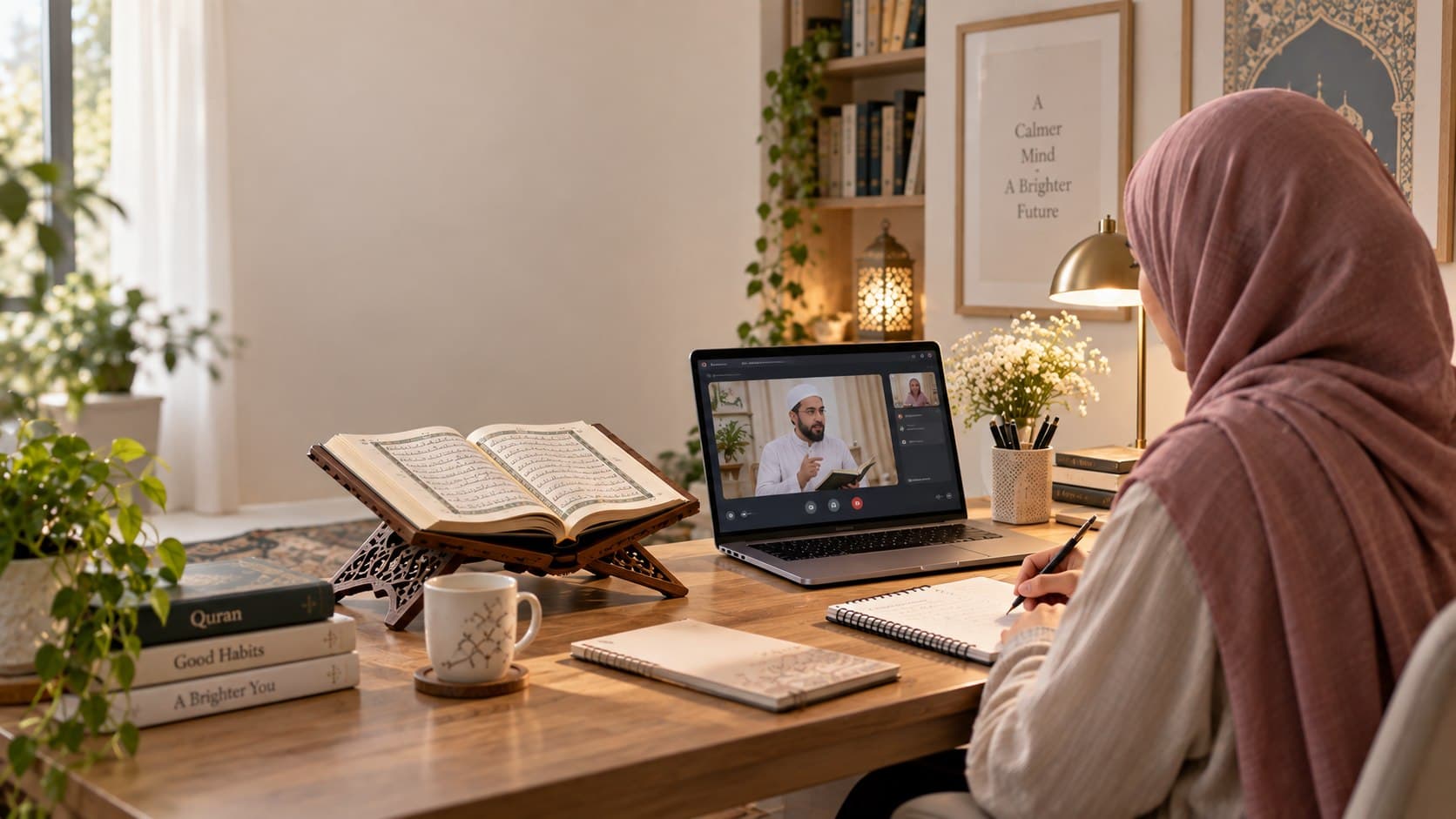
Women search for online Quran classes when the wish is already there and the week is not. Some have never read a line. Some can, and want it cleaner. Some are returning after years. Some want a quiet corner at home more than they want a classroom. The useful question is not “do classes for women exist?” It is how to choose a path that matches your goal, your level, your hours, and the conditions you actually need in order to recite out loud.
This is a practical guide to online Quran classes for women — learning from home as a complete experience. It is not a female-teacher hiring page, not a ten-point teacher scorecard, and not a class-format explainer for families. Those live in female Quran teacher online, how to choose the right online Quran teacher, and online Quran classes for kids and adults. This page stays with the learner: what to study, how to arrange the week, and what comfort actually requires of a class.
Can Women Learn the Quran Effectively Online?
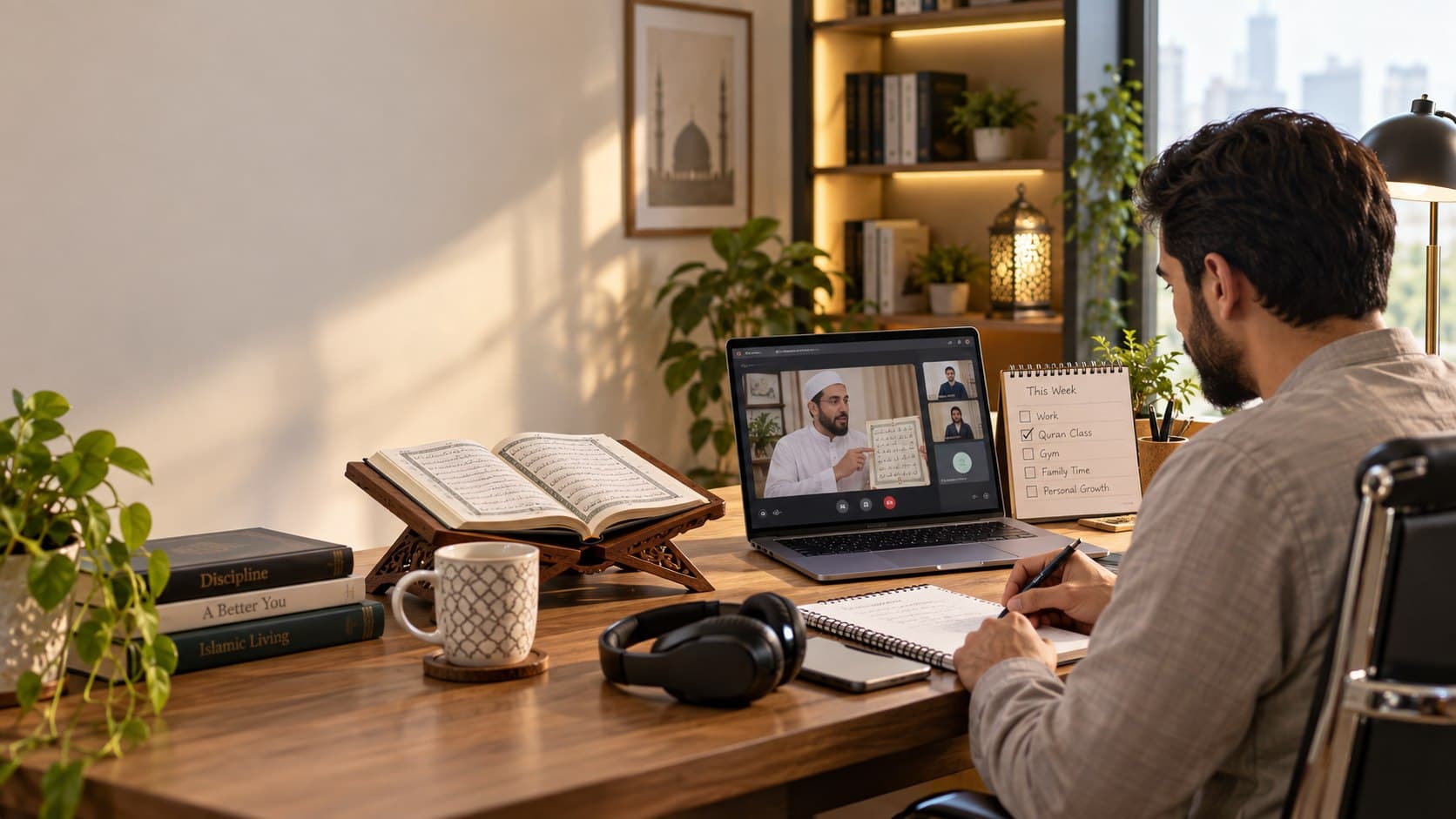
Yes, when the class is live, you recite, and someone who can hear you corrects the sound. A laptop does not make that automatically better than a local teacher. It removes travel and can sit inside a house you already live in. Suitability still depends on the instruction, the slot you can keep, and whether the format matches how you learn — one-to-one, a beginner primer, or correction on pages you already read.
Consistency decides more than the brand name. A 30-minute weekday lesson you attend will usually outrun a more impressive plan you miss. Online learning is a tool. It is not a guarantee.
Why Women Choose to Learn the Quran Online
The reasons are practical, and they are not all the same. Learning from home can mean no commute after work, no search for a local class that fits, and a lesson that can sit after children sleep or before a university day. Some women want a private call rather than a mixed room. Some simply want structured instruction they can keep while the rest of life continues.
Not every woman is a mother. Not every woman has a 9-to-5. Not every woman wants the same teacher gender. The common thread is a week that already has owners, and a desire to put Quran learning on that week without pretending the week is empty.
Who Can Benefit From Online Quran Classes for Women?
Anyone who will actually recite on the call. The course should change with the starting point, not with a label on a sales page.
Complete beginners
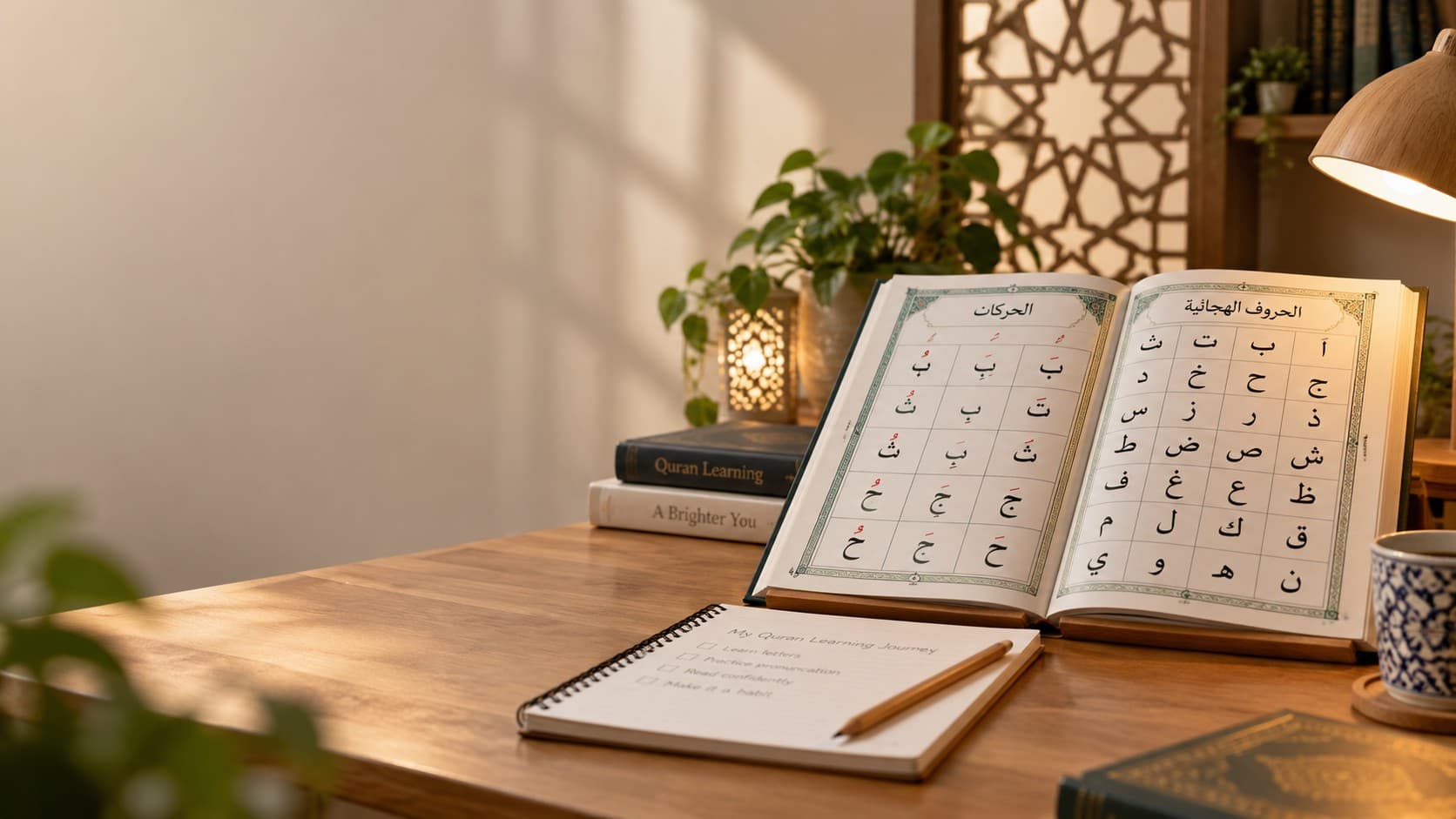
Letters, sounds, joining, then a primer such as Noorani Qaida. You do not need spoken Arabic to begin reading the script. The adult starting map is in how to learn Quran from scratch as an adult— the work is the same whether you are a sister or not; the class still has to treat you as an adult.
Women who can already read Quran
Fluency, fewer guessed words, pronunciation that still mixes similar letters. Quran Reading (Nazra) is the usual path. You do not need to return to page one of a primer unless the foundation is actually missing.
Women returning to Quran learning
Childhood lessons often leave fragments. A teacher should hear the first unstable point and start there — not perform a restart because it looks more “serious.” Feeling rusty is ordinary. It is not evidence that the skill is closed.
Women learning for Tajweed
Named rules on lines you can already follow. Quran with Tajweed when the page can carry them. What Tajweed is, and what it is not, is in What Is Tajweed?. Correct sounds begin with the first letter. A complete rulebook is not required before you may open a page.
Women interested in Hifz
Memorization stores whatever reading you currently have. If the line is still guessed, Hifz will store the guess. See how to start Hifz before adding a second job to a week that already struggles.
What Should You Learn First?
The sequence depends on what is already stable. For a beginner, a common order is: Arabic letters, their sounds, connected forms, Harakat, a structured foundation such as Noorani Qaida, then short Quranic words, then basic Tajweed on lines you can already read. The reading-skill version of that path is in how to read the Quran correctly.
If you already read, start with an assessment: hear the line, name the recurring mistakes, then work pronunciation, Tajweed where it belongs, and fluency. Do not stack every goal onto the first 30 minutes.
Should You Learn Quran Reading, Tajweed, or Hifz?
They are different jobs. You can move from one to another over time. You cannot do all of them well in the same tired slot.
- Quran reading. Following the written line without guessing. The right first goal for most beginners.
- Tajweed. Place, quality, and measure of letters on pages you can already read. Not a sticker you earn after a weekend.
- Hifz. Memorization with revision. Later, if the reading is stable enough to store.
None of these is inherently more “serious.” A clean beginner line is already Quran learning. A rushed Hifz of an unstable page is not a higher rank.
What Should You Look for in an Online Quran Academy?
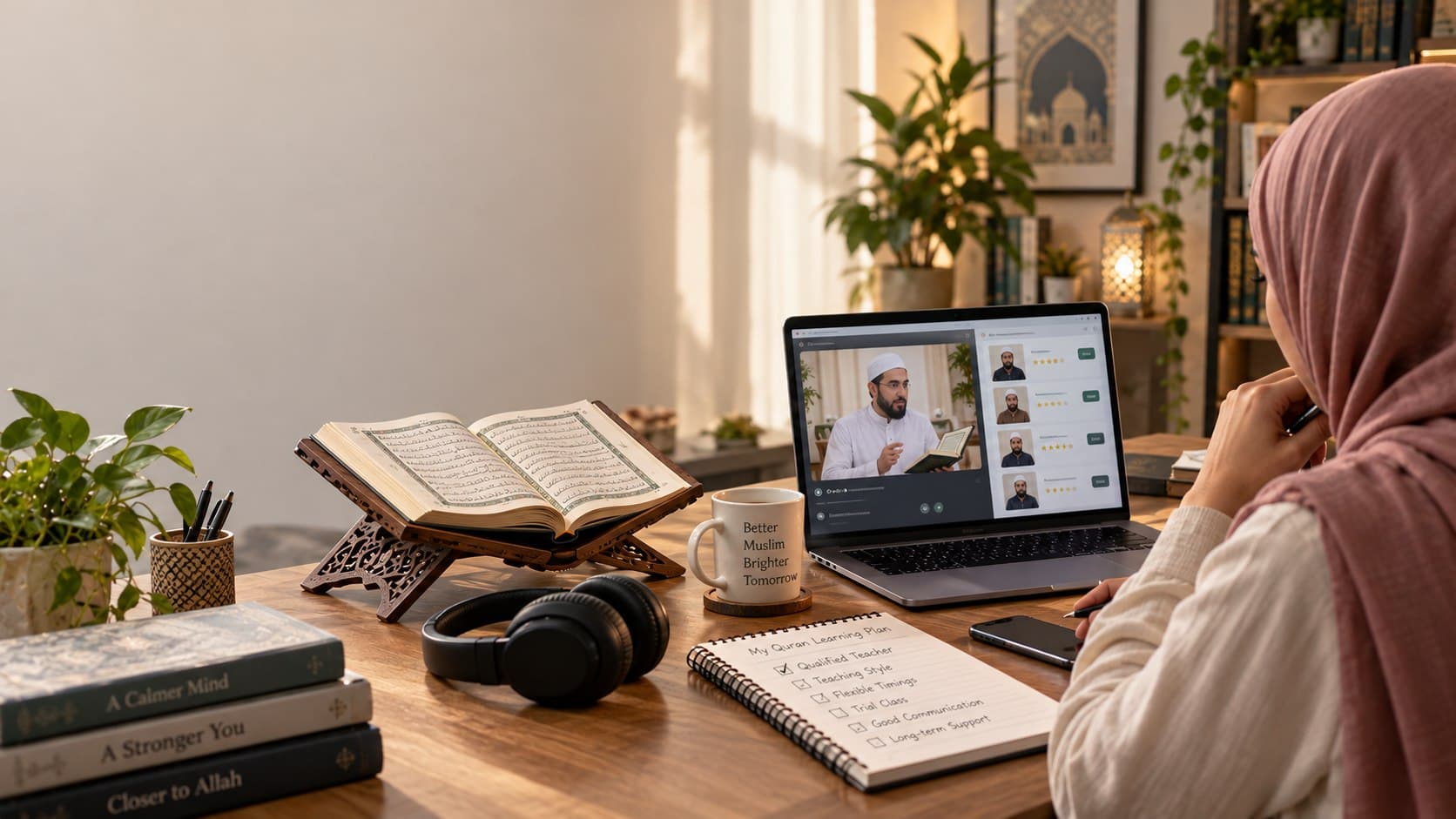
You are hiring a weekday class you will still attend, not a slogan about sisters. A short evaluation — not a ranking of academies:
- A published course path that matches your actual level
- A teacher who can teach that subject, not only appear in a photo
- Level assessment that starts by hearing you
- Pronunciation stopped and modelled on the word
- A slot that exists in your real week
- Pricing you can see before you pay
- A trial that opens a page, not only a sales call
- Clear communication about practice and missed lessons
- A next step after each class, not only attendance
- A professional one-to-one environment you can keep
How to judge the person on the call is in how to choose the right online Quran teacher. This list is only: does the academy make those checks possible?
Privacy and Comfort Considerations for Women
Comfort is personal. It is not a single arrangement that every woman requires, and this page does not issue a religious ruling on teacher gender, cameras, or hijab. Some learners prefer a female teacher. Some do not mind who is on the call if the recitation is clear. Some want the door closed. Some can learn at a kitchen table. Some want the camera on so the teacher can see the page; some will ask what the academy actually requires. Ask, rather than assuming a policy that was never published.
What you can reasonably expect: professional conduct, a private one-to-one call rather than a public classroom, and the chance to name a teacher-gender preference if that matters to you. Fahm-ul-Quran is not a women-only academy. A female Quran teacher is available; preference is reviewed when a trial request is handled, and it is not an instant assignment. The teacher-gender question in full is in female Quran teacher online.
Home environment matters as much as the teacher. A class you cannot recite in — because the room is public, the connection fails, or someone else is performing the lesson — will not store a sound. Arrange the corner. The academy cannot invent privacy you do not have in the house.
How to Fit Quran Classes Around Work, Family, or Study
Reserve a weekday window. Do not wait for a free afternoon. Live classes at Fahm-ul-Quran run Monday to Friday; weekend live classes are not offered. Independent practice can sit on any day you can keep — including a quieter weekend morning. Mothers, students, shift workers, and people with no children all need the same honest test: will this clock still exist in week six?
If the obstacle is a full-time job rather than “being a sister,” the calendar guide is how to learn Quran online for busy adults. If a roster moves, protect the duration and tell the teacher. Shrink practice before you cancel the live appointment.
A Practical Weekly Quran Routine for Women
An illustrative week — not a prescription. Change the days to match your life. Live lessons sit on weekdays because that is when classes run.
- Monday. Live 30-minute lesson.
- Tuesday. 10–15 minutes on the assigned line.
- Wednesday. Short reading of the same material; mark the word that still fails.
- Thursday. Live lesson — bring the marked word.
- Friday. Brief review so the weekend does not erase the week.
- Weekend. Optional longer practice if energy exists. Not a second live class.
Two live days plus short review will usually beat five classes you cannot attend. What to repeat between calls is in practising Quran recitation at home.
What Does an Online Quran Lesson Usually Look Like?
Academies differ. One workable live shape — not a law — is: greet and open the same book, review yesterday’s line, take a small new piece, read aloud, stop and model the errors that actually appeared, ask a question if you have one, leave with a next step small enough to practise. A pleasant conversation that never opens a page is not a Quran class. Neither is a rush through extra material so the session looks productive.
What If You Are Starting From Zero?
Not knowing Arabic, mixing joined letters, reading slowly, and disliking the sound of your own mistakes are ordinary starting conditions. They are not a verdict on age. An adult beginner is not a child in a smaller chair. The content may start at letters. The conversation should still treat you as an adult.
Start at the first unstable skill. Stay slow. Get a teacher who will hear you. Skip the promise that you will be fluent in a set number of days. The primer, if joining is not yet solid, is explained in Noorani Qaida for beginners.
What If You Already Know How to Read Quran?
Then the class should not pretend you are a beginner. Work the mixed pair, the madd that keeps collapsing, the line that is accurate but slow, the confidence to read an unfamiliar short word without guessing. Formal Tajweed is useful when those pages can carry named rules. It is not mandatory as a complete science before you may improve a sound you already have.
How to Know Whether an Online Quran Class Is Working for You
- The same similar letters mix less often
- Yesterday’s line still holds
- A correction from last week appears on this week’s page
- You can name what you are working on, not only that you “had class”
- You still attend in a difficult month
- The goal for this season is smaller than a khatam, and it is moving
Attendance alone is not progress. A teacher saying “that kasra held” is better evidence than a week of silent confidence.
Common Mistakes When Choosing Online Quran Classes
These are habits that show up around this search. They are not unique to women.
- Choosing only on price, then never being heard
- Joining a “sisters” label without asking what the first month contains
- Booking an hour the household cannot keep
- Starting too high because a primer feels embarrassing
- Treating teacher gender as the whole decision
- Never asking whether pronunciation will be stopped on the call
- Expecting fluency because the trial felt encouraging
- Trusting advertising instead of one heard page
Questions to Ask Before Joining an Online Quran Academy
A short list for this decision. The academy hiring checklist — platforms, languages, refunds — is in questions to ask before you choose an online Quran teacher.
- What level will I start at after you hear me?
- What will I learn first this month?
- Are lessons live, and will I recite?
- How is pronunciation corrected on the word?
- Can a weekday slot fit the life I actually have?
- Is there a trial, and is it a request or instant enrolment?
- How will we know last week’s correction was applied?
- Which courses exist if my goal is reading, Tajweed, or Hifz?
- Can I begin from Noorani Qaida if that is the honest level?
- What happens if I miss a weekday lesson?
How Fahm-ul-Quran Online Academy Can Support Women Learners
If you want this kind of week with someone listening, Fahm-ul-Quran teaches live and one-to-one. Quran for Sisters is the course shaped around women and girls; the same academy also teaches Noorani Qaida, Quran reading, Tajweed when the page is ready, and Hifz when reading can carry it. Classes are 30 minutes, Monday to Friday, on WhatsApp, Zoom, or Skype. A female Quran teacher is available; you can also request no preference, or a male teacher. Preference is reviewed with the trial request — it is not a guaranteed assignment.
You can meet the teachers, see published pricing (no admission fee), and read how a trial request works. A 3-day completely free trial is a request, not instant enrolment. Weekend live classes are not offered.
Ready to make Quran learning part of a week you already live? Request a free 3-day trial — 30 minutes, completely free. Use it to test the path, the hour, and the person on the call, then decide.