Noorani Qaida for Beginners: How to Start Learning Quran Reading
What Noorani Qaida is, who actually needs it, how to practise the primer, and what usually comes next — without a 15-day completion promise.
16 September 2026 · 13 min read · Fahm-ul-Quran Online Quran Academy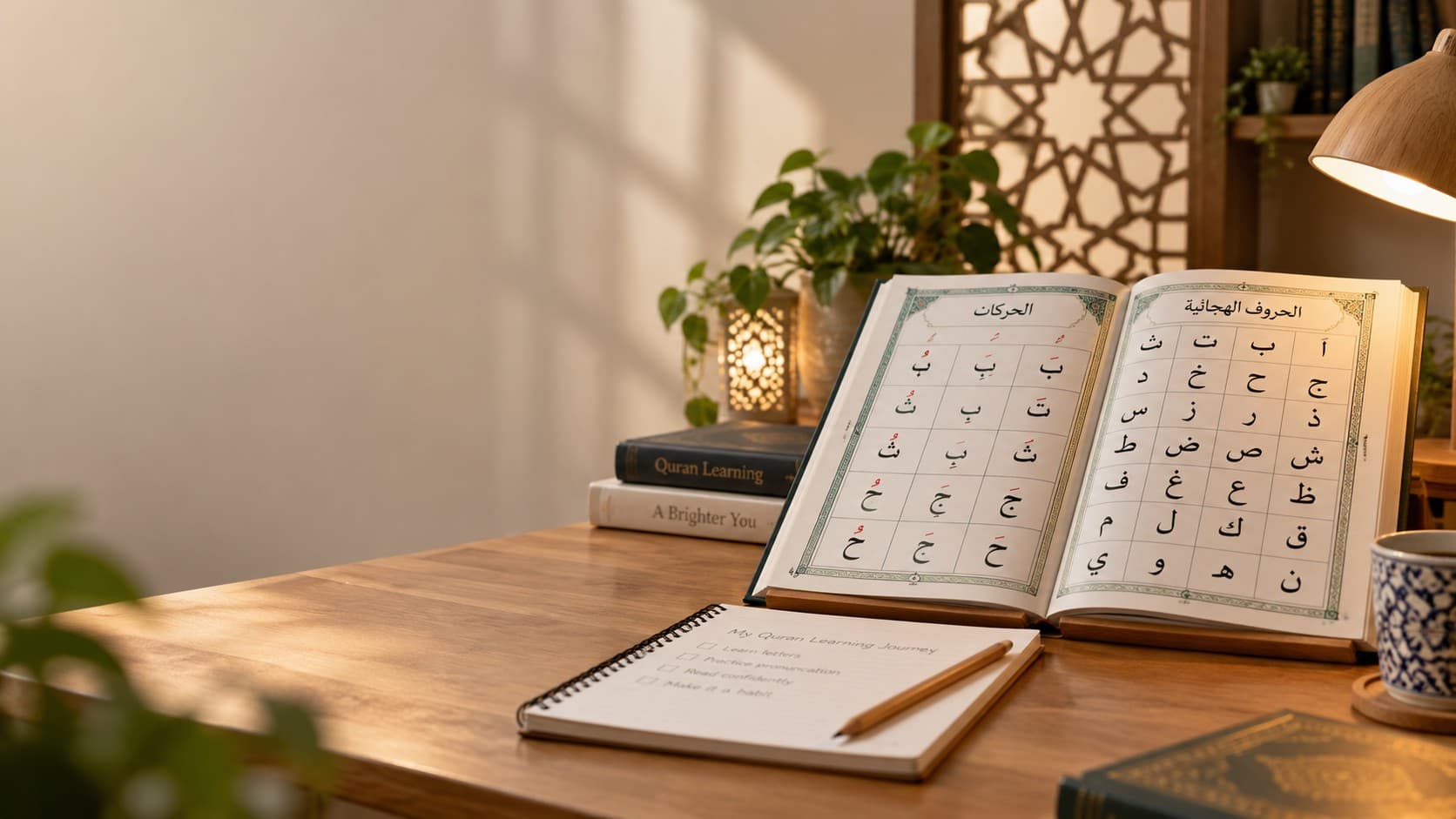
Many people want to read the Quran and then stall on the first page. The stall is rarely laziness. Letters were never settled, joining was guessed, or childhood lessons thinned out until a mushaf looked familiar and still unreadable. They hear “start with Noorani Qaida” and still do not know what that book is for — or whether they need it at all.
This guide is about that primer: what it teaches, who it helps, how to practise it, and what usually comes next. It is not a claim that every Muslim must use one specific book. Other primers teach the same skills. It is not the full beginner class menu — that first-step question is in online Quran classes for beginners— and it is not the whole learning sequence in how to learn Quran online. This page stays with Noorani Qaida.
What Is Noorani Qaida?
Noorani Qaida is a foundational primer commonly used to teach Quran reading skills. It walks a student from single Arabic letters to joined forms, short words, and lines that look like Quranic writing. It is not the Quran. It is a workshop for the skills the Quran will demand: recognition, sound, joining, vowel marks, and a calm pace.
Teachers in many South Asian traditions use it because the progression is visible on the page. You can see whether a letter holds before you pretend you are reading a surah. Fahm-ul-Quran uses it as the usual first book when a student cannot yet read connected Arabic reliably. It is still not the only possible primer. The method matters less than whether someone can hear you and refuse to let a guessed letter pass.
Who Should Learn Noorani Qaida?
A starting point should be heard, not assumed. “Beginner” covers several classrooms. Some people need page one. Some need the joining pages. Some already read and would waste months repeating isolated alif.
- Complete beginners, for whom Arabic letters are new or almost new.
- Children starting Quran reading for the first time.
- Adults who never learned the foundations properly, or who feel late.
- People who learned as children and the knowledge thinned out.
- Learners who recognise isolated letters but cannot combine them without guessing.
- Learners who can already follow a line slowly and need stronger foundations on the letters that still collapse — not necessarily the whole book from the cover.
If you are an adult restarting after years away, the adult roadmap is how to learn Quran from scratch as an adult. Ask a teacher to hear you before you buy a second copy of page one.
What Do You Learn From Noorani Qaida?
The book is a sequence, not a pile of facts. A teacher may skip a page you already have, or stay longer on one you do not. Treat this as the usual order of work, not an inaccurate textbook.
- Arabic letter recognition — the shape on the page.
- Pronunciation — the sound that belongs to that shape.
- Joining letters so a word does not collapse.
- Vowel marks, read rather than skipped or invented.
- Basic reading patterns: short combinations, then longer ones.
- Gradually more complex examples that look like Quranic writing, still without pretending you have finished a mushaf.
Named Tajweed rules are not the first job of this primer. Correct sounds begin with the first letter. The catalogue of madd and ghunnah usually waits until a line can carry them. Similar-letter habits that show up here are also covered, as reading mistakes, in common Quran reading mistakes beginners make.
Why Is Noorani Qaida Helpful for Quran Beginners?
It is helpful when the alternative is opening a mushaf and inventing vowels to keep moving. A primer makes that habit harder to hide. The progression is systematic: you can see whether yesterday’s letter still holds. Pronunciation has a place to be stopped. Confidence comes from a line you can actually read, not from finishing a prettier book.
It does not guarantee fluency. It does not replace a teacher. It does not make every student ready for Quran reading on the same calendar. What it can do is prepare the mouth and the eye for the page that comes next.
How to Learn Noorani Qaida Step by Step
Use this as a process. A teacher who hears you may change the order.
- Identify your current level — letters, joining, or short lines.
- Learn or review the letters that are still uncertain.
- Practise pronunciation until similar letters stay distinct.
- Learn the basic reading marks you actually meet on the page.
- Practise combinations: two letters, then a short word.
- Read increasingly difficult examples without racing.
- Review regularly — yesterday’s page before today’s new one.
- Apply the foundations to Quran reading when the teacher hears that a short line can be read, not recited from last week’s memory.
Fahm-ul-Quran’s Noorani Qaida course is built for that patience: one-to-one, live, so the lesson can stop on a single letter.
How Much Should You Practise Noorani Qaida?
These are example routines, not universal requirements. Short and repeatable beats a long session that never happens. There is no honest daily duration that fits every home.
A 15-minute example
- 5 minutes — review yesterday’s letters or line
- 5 minutes — new material from the last lesson
- 5 minutes — reading those examples aloud, slowly
A 30-minute example
- 10 minutes — review
- 10 minutes — new material
- 10 minutes — guided reading of the same pages
If you only have ten minutes, keep the last lesson. Drop extra pages you invented because you felt behind. What to do in those minutes, for any recitation, is in how to practise Quran recitation at home.
Common Noorani Qaida Mistakes Beginners Make
- Rushing through lessons. Solution: stay until the letter holds. Turning pages is not progress.
- Memorizing without understanding pronunciation. Solution: read the shape. Reciting last week’s memory on a new page will fail as soon as the teacher points elsewhere.
- Skipping difficult exercises. Solution: the hard pair of letters is the work. Skip it and it returns on the mushaf.
- Inconsistent practice. Solution: a short slot you can repeat. A missed day is ordinary; a two-week pause is how the sound slips.
- Moving forward before foundations are secure. Solution: ask the teacher to hear the weak letter again. A prettier next page will not fix it.
- Practising without correction. Solution: a live lesson to catch what you cannot hear yet. Recordings help review. They do not tap the desk.
- Being embarrassed to repeat basic lessons. Solution: repeating a letter is the adult way to learn it. Embarrassment is common. It is not evidence that the skill is closed.
Can You Learn Noorani Qaida Online?
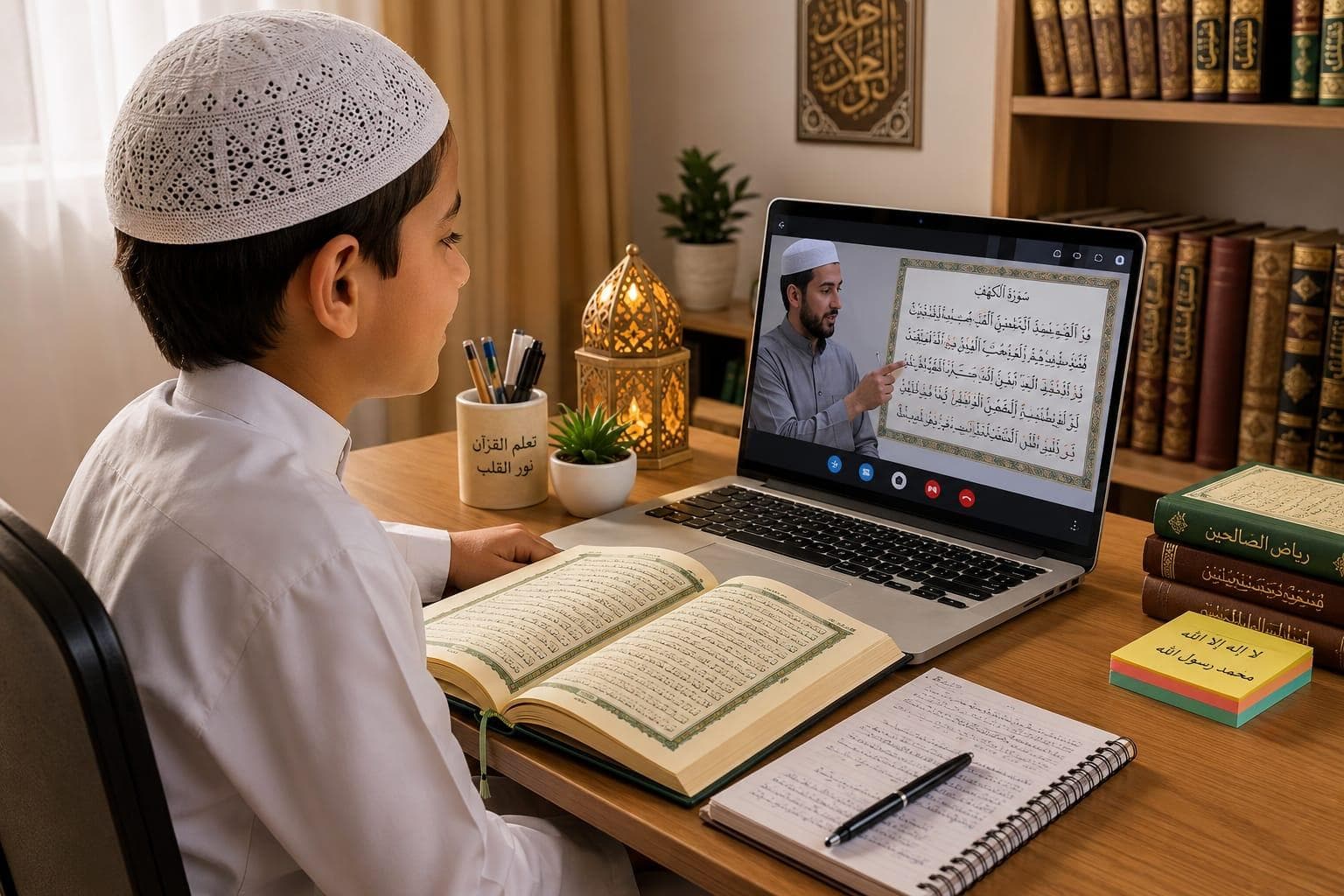
Yes, when the class is live and someone hears you. At Fahm-ul-Quran the lesson is 30 minutes, one-to-one, Monday to Friday, on WhatsApp, Zoom, or Skype. You need a stable connection and a phone, laptop, or tablet. Weekend classes are not offered. Flexible timings are available on those weekdays.
The teacher listens, corrects pronunciation, and leaves a small next step. You practise that material between classes. How a first request is arranged is in how it works. Online is not automatically better than a local teacher. It is useful when the lesson is live and the starting page matches you.
How to Choose an Online Quran Teacher for a Beginner
A beginner needs patience more than a performance. Use this as a checklist, then test it in a trial.
- Experience teaching beginners, not only advanced reciters.
- Ability to correct pronunciation you can hear and copy.
- A patient approach: a guessed letter should not pass.
- Structured lessons: review, new work, a small next step.
- A pace that matches the student, not a syllabus calendar.
- Clear communication in a language you follow.
- A weekday slot you can keep.
- A trial you can treat as a test. Fahm-ul-Quran offers a 3-day completely free trial as a request, not instant enrolment.
A female Quran teacher is available. You can meet the teachers on this site. Fuller hiring questions sit in questions to ask before you choose an online Quran teacher.
What Comes After Noorani Qaida?
You move on when letters are recognised without a long pause, joining does not collapse, and a short line can be read with help rather than recited from memory. There is no badge. The teacher hears it. Learners progress at different speeds.
- Noorani Qaida foundations — or an equivalent primer.
- Quran reading (Nazra): page by page recitation with correction.
- Pronunciation improvement on the pages you already read.
- Tajweed foundations when those pages can carry named rules. See What Is Tajweed?.
- Continued recitation practice between live lessons.
Hifz is later. Memorization stores whatever reading you currently have. If that reading is still guessed, the guess is what you will keep.
How Long Does It Take to Learn Noorani Qaida?
There is no honest number of days or weeks that fits every student. Progress depends on age, starting level, lesson frequency, practice, consistency, pronunciation, and individual learning needs. Anyone promising completion in 15 or 30 days is selling a calendar, not a foundation.
Judge the week by whether yesterday’s letter still holds — not by how many pages you turned. How long Quran reading itself takes is a different question, with the same refusal of a fixed number, in how long it takes to learn Quran online.
Noorani Qaida for Adults vs Children
The foundational concepts can be learned by both. The teaching changes. Adults often need a weekday slot that survives work, permission to rebuild forgotten foundations without embarrassment, and a pace that does not talk down. Children often need more repetition, shorter bursts of attention, and a parent nearby for the device — not a second teacher correcting over the call.
A parent’s job is the space, the book, and the routine. Leave pronunciation to the person on the screen. How to sit beside a child’s lesson without taking over is in how parents can support a child’s online Quran lessons.
If You Need a Starting Page, Not a Guess
If you want to learn to read the Quran from the beginning, start with the skill your current reading can support. For many beginners that is a primer such as Noorani Qaida, with a teacher who will hear a letter and say “again — from here.” Fahm-ul-Quran Online Quran Academy teaches that path one-to-one and live. If you are unsure whether this is your first book, request a free 3-day trial — 30 minutes, completely free, treated as a request rather than instant enrolment. You decide after the trial.