How to Read the Quran Correctly: A Beginner's Step-by-Step Guide
A practical beginner roadmap for Quran reading: letters, joining, Harakat, a primer such as Noorani Qaida, then short words and gradual Tajweed — without a fake finish line.
16 September 2026 · 15 min read · Fahm-ul-Quran Online Quran Academy
People search “how to read the Quran correctly” when the page is already open and the line still will not hold. Some letters look familiar. Joining collapses. Vowel marks get skipped so the word can keep moving. The usual mistake is to treat “correctly” as a finish line — full Tajweed, a beautiful voice, a short surah by Friday. It is not. It is a sequence of small skills that have to sit on top of each other.
This guide is that sequence: letters, joining, Harakat, a structured primer, short Quranic words, then gradual Tajweed and practice. It is not a class-format explainer, not a primer textbook, and not a list of reading mistakes. Those live in online Quran classes for beginners, Noorani Qaida for beginners, and common Quran reading mistakes beginners make. This page stays on how to read the Quran correctly, one skill at a time.
What Does It Mean to Read the Quran Correctly?
For a beginner, “correctly” means the written line is being read, not guessed. You recognise the letter, you follow it when it joins, you apply the mark that is actually on it, and you give the sound a place in the mouth. You do not invent a vowel to keep moving. You do not skip a similar letter because it “looks close.”
Reading correctly does not mean mastering advanced Tajweed on day one. Named rules — madd catalogues, noon cases, stopping charts — need a line they can sit on. Correct sounds begin with the first letter. The rest arrives when the page can carry it. Speed is not part of the definition. A slow accurate line is already correct reading. A fast guessed one is not.
Can Anyone Learn to Read the Quran?
Yes, at different ages and starting levels. Complete beginners start with shapes and sounds. Adults who never learned, or who forgot, start at the same skills without being talked down to. Children need shorter bursts and more repetition. People who speak Arabic already have an advantage on some sounds and still may need Quranic joining and marks. People who do not speak Arabic can still learn to read the script; meaning is a later, separate effort.
Consistency and a teacher who will hear you matter more than a calendar . If you are an adult restarting, the adult path is how to learn Quran from scratch as an adult. Once a line exists and you want it cleaner, that improvement work is in how to improve Quran recitation. This page stays the shared reading-skill map.
Step 1 — Learn the Arabic Letters
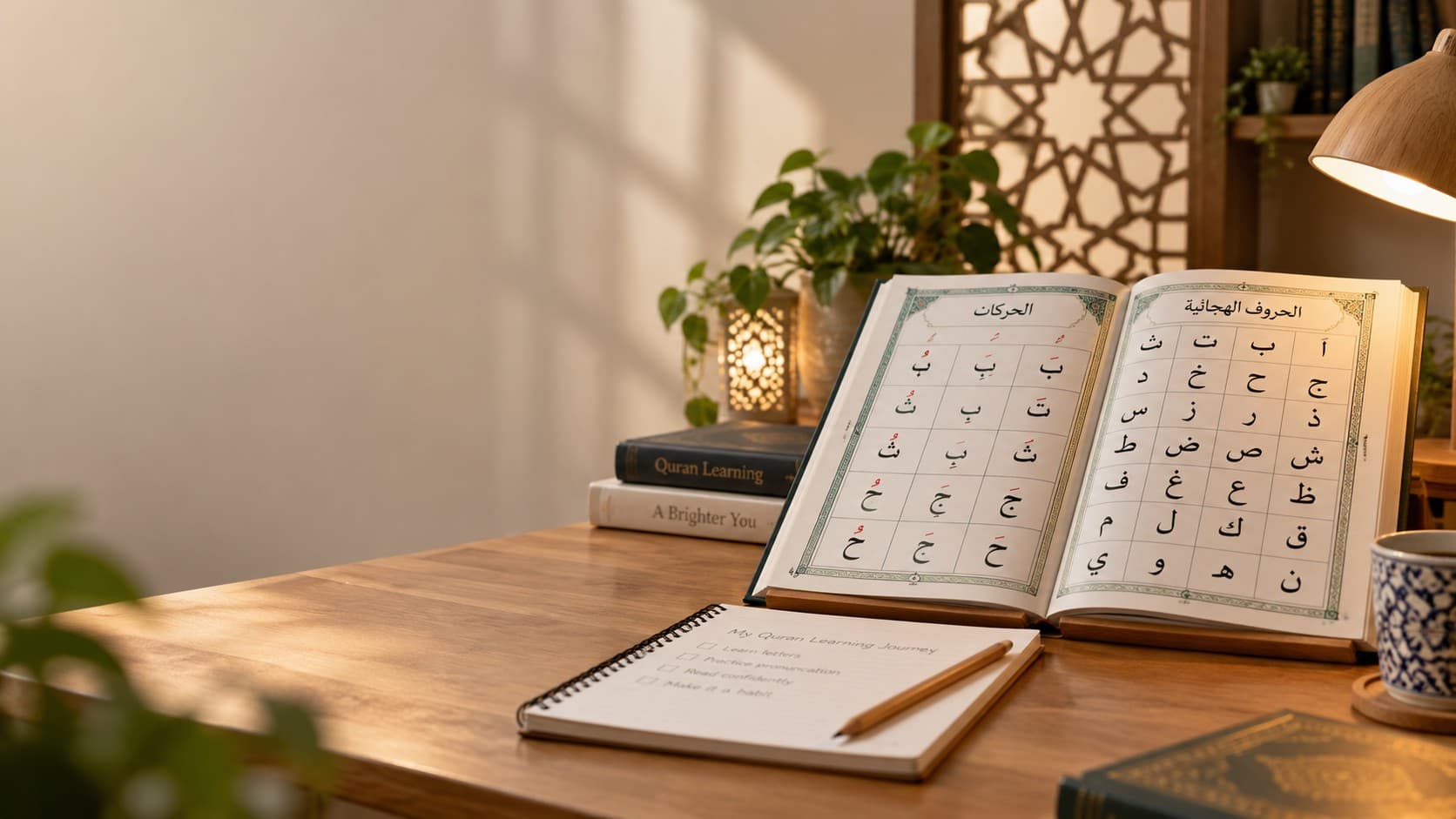
Quranic writing uses the Arabic alphabet. There are twenty-eight letters. Your first job is not grammar and not conversation. It is to recognise the shape, give it its sound, and keep similar letters from collapsing into each other.
Some letters share a skeleton and differ only by dots: ب ت ث, or ج ح خ. If the eye treats them as one letter, the mouth will too. Learn the isolated form first, then the sound. Say the Arabic sound — not an English lookalike. ب is not the English “b” in every detail; ق is not a hard English “k.” A teacher can stop you on that difference. A chart cannot.
You do not need to finish all twenty-eight before you meet a vowel mark. You do need the letters in front of you to be stable enough that a mark has somewhere to sit.
Step 2 — Learn How Letters Join Together
Isolated letters are not Quran reading. On the page, most letters change shape depending on whether they sit at the beginning, middle, or end of a word. ب looks like ب on its own, like بـ at the start, like ـبـ in the middle, and like ـب at the end. The sound is the same. The eye has to learn the family.
A few letters do not connect to what follows them: ا د ذ ر ز و. After one of those, the next letter starts a new visual group. Beginners who have only drilled isolated charts often freeze here. That freeze is not a lack of intelligence. It is a missing joining drill.
Practise short connected pairs before long words. If joining still collapses, stay here. Opening a mushaf will not teach the middle form.
Step 3 — Learn Harakat and Basic Reading Signs
Harakat are the small marks that tell you how a letter is vocalised. Without them, beginners guess. With them, the page is giving instructions. Learn the mark, then a small example, then why it matters.
Fatha
A fatha (َ) is a short “a” sound on the letter. بَ is read “ba,” not “bee” or “boo.” It sits above the letter. If you skip it, you invent a vowel or flatten the letter into silence.
Kasra
A kasra (ِ) is a short “i” sound. بِ is “bi.” It sits below the letter. Mixing kasra and fatha is one of the earliest habits a teacher will stop, because the mouth can do it — the eye has not yet learned to look down.
Damma
A damma (ُ) is a short “u” sound. بُ is “bu.” It sits above the letter, in a different shape from fatha. Three short vowels. Three different instructions. Read the one that is written.
Sukoon, tanween, shaddah, and madd
Sukoon (ْ) means the letter has no vowel of its own: you pass through it without adding a, i, or u. Tanween (ً ٍ ٌ) adds a noon sound after the short vowel — “-an,” “-in,” or “-un.” Shaddah (ّ) doubles the letter: you hold it, you do not tap it once. Madd is elongation: some vowels are held longer than a short fatha. Learn these as they appear on your current page, not as a catalogue to memorise before you can read بَ.
Step 4 — Learn Through Noorani Qaida or a Structured Beginner Method
A primer such as Noorani Qaida exists so the skills above have a visible order: letters, sounds, combinations, Harakat, sukoon, tanween, shaddah, madd, then patterns that look like Quranic writing. It is not the Quran. It is a workshop. It is not the only valid method. Other books teach the same sequence. Skipping a foundation because a mushaf feels more “real” usually means guessing.
Fahm-ul-Quran uses Noorani Qaida as the usual first book when joining is not yet reliable. Who actually needs the primer, and what comes after it, is in Noorani Qaida for beginners. This step is only: do not skip the workshop.
Step 5 — Start Reading Short and Simple Quranic Words
Move to the mushaf when a short line can be read with help, not recited from last week’s memory. Start with short words and short passages. Sound them out. Repeat the difficult word. Stay slow. Accuracy before speed. A long surah you race through is not progress. A short word you can still read tomorrow is.
Quran Reading (Nazra) is the academy path for that stage: page by page recitation with correction. Do not jump to Hifz to feel more serious. Memorization stores whatever reading you currently have.
Step 6 — Learn Basic Tajweed Gradually
Tajweed is how letters are meant to be recited: place, quality, and measure. For a beginner it improves pronunciation, elongation, stopping without swallowing the last letter, and the difference between letters that sit in the same neighbourhood. It is not a sticker you earn after a weekend, and it is not required as a complete science before you may open a page.
Learn it progressively, on lines you already read, with someone who can hear you. The definition, and what Tajweed is not, is in What Is Tajweed?. How to practise those sounds at home is in how to learn Quran with Tajweed at home.
Step 7 — Practise Correct Pronunciation
Quranic letters have exit points — throat, tongue, lips, nasal passage. Similar letters stay mixed until someone stops you. Listen, repeat slowly, then read the same word on the page. A small change of place can turn one word into another. That is a reason to be careful, not a reason to freeze. You do not need a ruling on every recitation to justify practising the sound that is written.
Teacher correction is the shortest path through a mixed pair. Recordings help you review a sound already checked. They will not tap the desk when two letters still share a neighbourhood in your mouth.
Step 8 — Build a Consistent Quran Reading Practice
This is an illustrative 10–15 minute routine, not a universal prescription. Short and repeatable beats a long session that never happens.
- 3 minutes — revision of yesterday’s letters or words
- 5 minutes — new material from the last lesson
- 5 minutes — reading those examples aloud, slowly
- 2 minutes — mark the word that still fails, for the teacher
If you only have ten minutes, keep the assigned line. Extra pages you invent become a second curriculum. The fuller homework method is in how to practise Quran recitation at home.
Common Mistakes Beginners Make When Reading the Quran
These are habits, not character. Typical slips on the page — and calmer ways to work on them — are in common Quran reading mistakes beginners make. Here is the reading-skill version, once:
- Reading too quickly, so marks and joins never exist.
- Guessing unfamiliar words instead of sounding them out.
- Ignoring vowel marks because the word “looks known.”
- Confusing similar letters and hoping close is enough.
- Skipping the primer to reach a prettier mushaf.
- Practising without anyone who can hear the error.
- Treating speed as the goal instead of a line that holds.
- Avoiding mistakes by staying silent — which stores nothing.
- Practising in rare marathons instead of a slot you can keep.
Should You Learn Quran Reading With a Teacher?
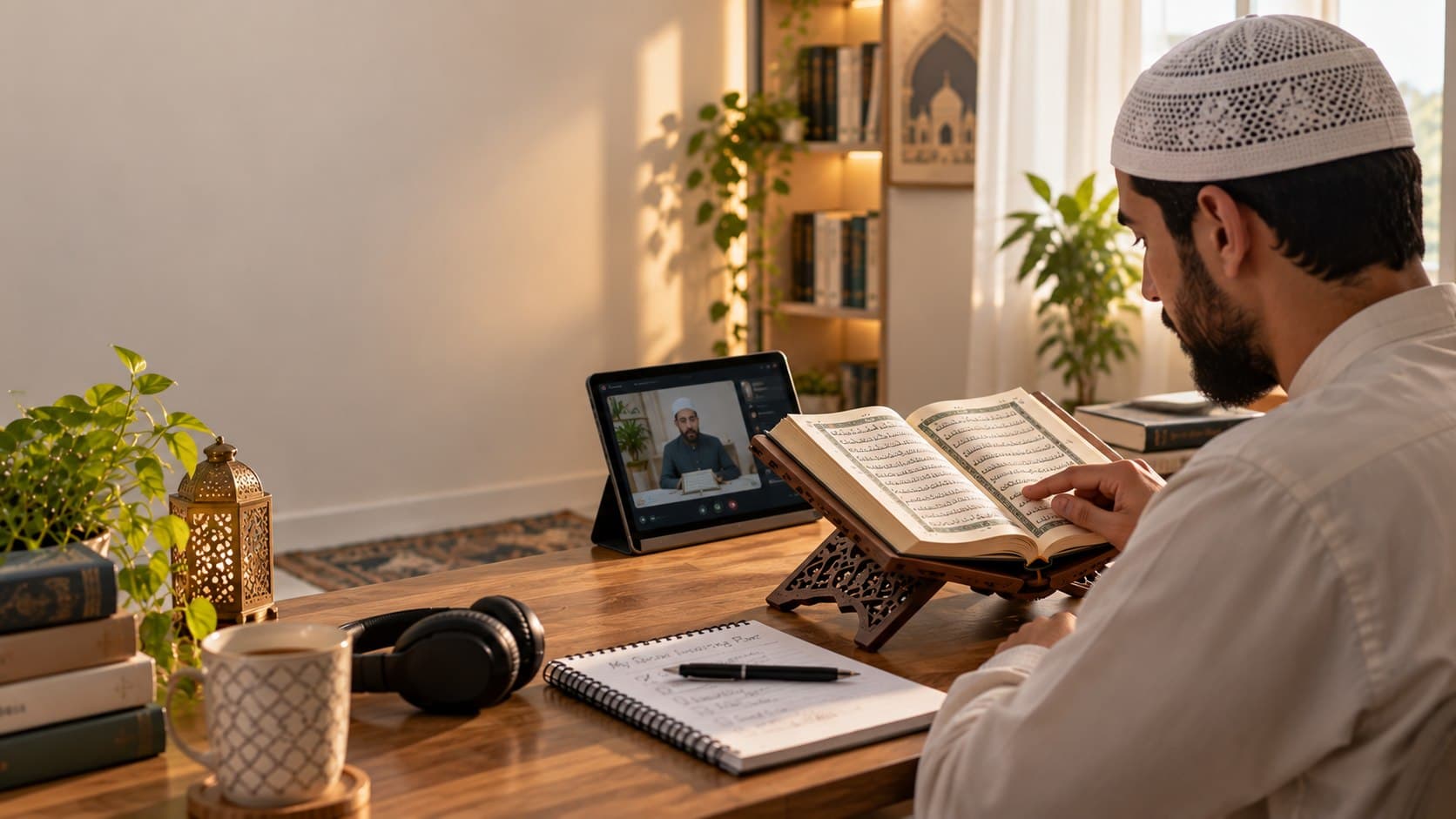
Self-study can teach names and give you listening hours. A teacher can stop a guessed letter, change the pace, keep a simple lesson structure, and remember last week’s weak pair. Pronunciation is the part self-study handles least well. Direct feedback is not a moral requirement. It is how the mouth finds a place it cannot see in a mirror.
How Online Quran Classes Can Help Beginners
Online helps when the class is live and one-to-one. You recite. The teacher corrects immediately. The pace matches you. You practise the same material between lessons. At Fahm-ul-Quran the lesson is 30 minutes, Monday to Friday, on WhatsApp, Zoom, or Skype. Flexible timings sit on those weekdays. Weekend classes are not offered. You need a stable connection and a phone, laptop, or tablet.
How live classes are run, and who they suit, is in online Quran classes for kids and adults. How a first request is arranged is in how it works.
How Long Does It Take to Learn to Read the Quran?
There is no honest number of days. Time depends on starting level, age, previous exposure, lesson frequency, independent practice, pronunciation habits already stored, consistency, and whether someone hears you. Anyone promising fluency in a set number of weeks is selling a calendar. Judge the week by whether yesterday’s line still holds. The timeline question, without a fake finish line, is in how long it takes to learn Quran online.
How to Know You Are Improving
- Do you recognise letters without a long pause?
- Can you follow a letter when it joins?
- Are fatha, kasra, and damma being read rather than skipped?
- Are the same similar letters mixing less often?
- Can you sound out an unfamiliar short word instead of guessing?
- Does Quranic script look like a page, not a decoration?
- Can you apply last week’s correction on this week’s line?
A teacher saying “that kasra held” is better evidence than a week of silent confidence.
Beginner Quran Reading Checklist
Progress is step by step. You do not tick every box in the same week.
- Arabic letters recognised on the page
- Letter sounds distinct, including similar pairs
- Connected forms (beginning, middle, end)
- Harakat: fatha, kasra, damma
- Sukoon
- Tanween
- Shaddah
- Madd, as it appears on your current page
- Basic Tajweed on lines you already read
- Pronunciation practice with someone who can hear you
- Regular short reading, not rare marathons
- Teacher correction applied the following session
What Should You Learn After You Can Read the Quran?
Not every learner follows the same next step. A common order, not a law:
- Strengthen fluency on pages you already read slowly.
- Improve Tajweed on those pages — Quran with Tajweed when the line can carry named rules.
- Keep pronunciation work on the letters that still mix.
- Read regularly, at a pace you can repeat.
- Learn meanings and translation as a separate effort.
- Continue recitation improvement with someone listening.
- Progress toward memorization only if the reading is stable enough to store. See how to memorize the Quran.
Learning to Read the Quran With Fahm-ul-Quran Online Academy
If you want this sequence with someone listening, Fahm-ul-Quran teaches it live and one-to-one: Noorani Qaida, Quran reading, and Tajweed when the page is ready. Classes are 30 minutes, Monday to Friday, with flexible timings. A female Quran teacher is available. You can meet the teachers and browse the course list. A 3-day completely free trial is a request, not instant enrolment.
Ready to start with guidance rather than a guessed first page? Request a free 3-day trial — 30 minutes, completely free. You decide after the trial.