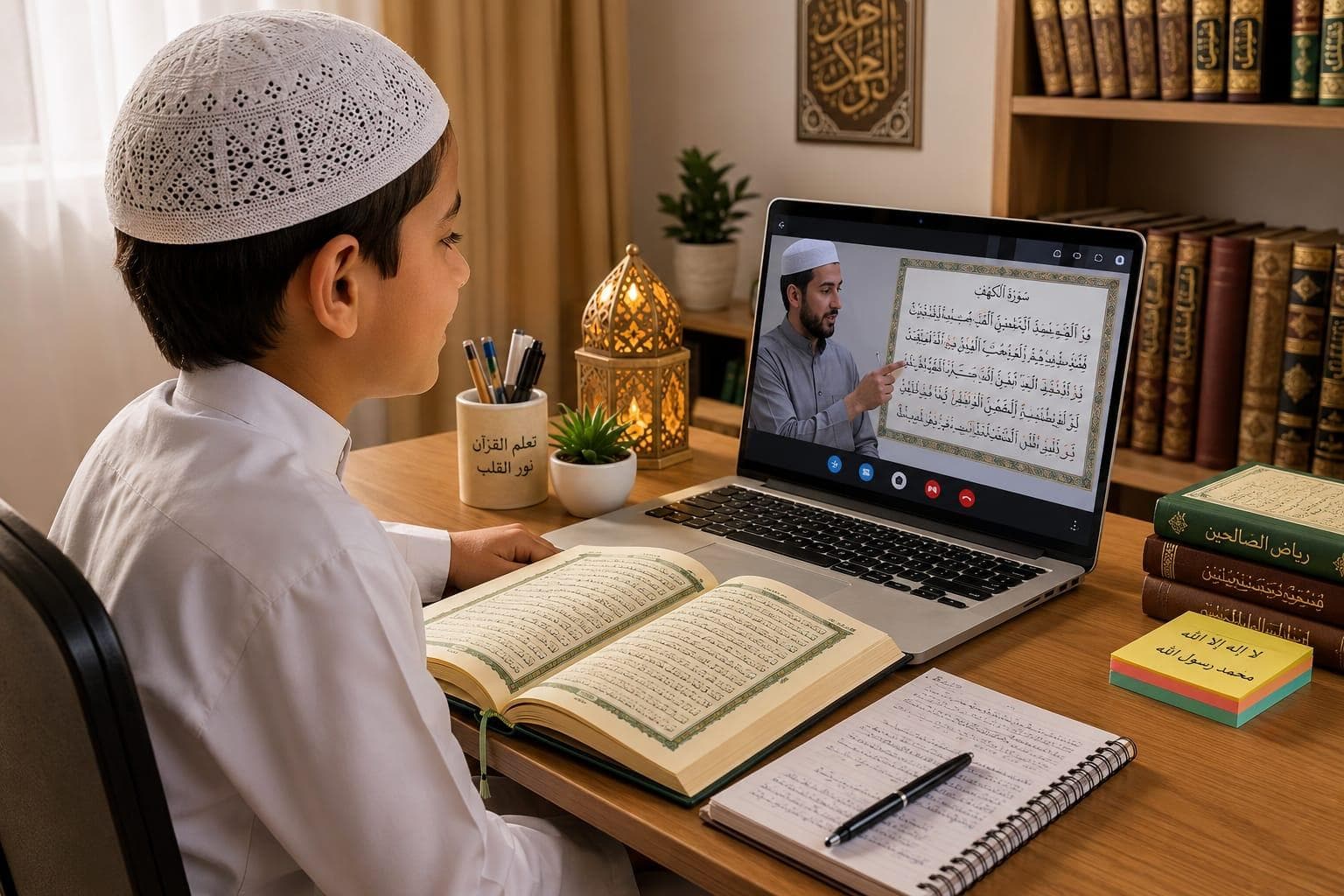
How to Learn Quran with Tajweed at Home: A Step-by-Step Guide
A practical home method for Quran with Tajweed: what to learn first, a simple practice routine, and when a live teacher should hear the sound you cannot hear yet.
16 September 2026 · 14 min read · Fahm-ul-Quran Online Quran Academy
Many people can already follow a Quranic line and still feel the recitation is approximate: letters sit too close together, madd is guessed, a noon is swallowed. They are not looking for a definition of Tajweed. They want to know how to learn Quran with Tajweed at home — what to practise first, and how to tell whether the sound is actually improving.
Home study can teach names and give you hours of listening. It cannot reliably hear the mistake you have been repeating. This guide is a practice method, not a Tajweed textbook, and not a general homework plan. What Tajweed is, and is not, is in What Is Tajweed?. How to review last week’s live lesson — any recitation, not only named rules — is in how to practise Quran recitation at home. A broader improvement framework, not only Tajweed drills, is in how to improve Quran recitation.
What Is Tajweed?
Tajweed is the set of principles teachers use so Quranic letters and words are recited from their place, with their qualities, in the measure the recitation requires. In ordinary Arabic the word is about doing something well. In recitation it is a practical standard: this letter from here, this length, this nasal sound or not.
You do not need spoken Arabic to begin. You do need to accept that some Quranic sounds do not exist in English or Urdu in the same way, and that the ear has to be trained. Correct pronunciation matters because a small change of place can turn one word into another, and because a guessed sound practised daily becomes a habit that is hard to unwind — especially if you later memorise it. This article does not issue a legal ruling on every recitation. It describes how to practise the sounds carefully at home.
Can You Learn Tajweed at Home?
Yes, in part. Self-study can teach you the name of a rule and where it appears on the page. Listening to a reliable recitation and repeating slowly can train the ear. A simple routine can keep that work from becoming a once-a-month marathon. None of that is useless.
What home study cannot do well is catch a sound you have been practising incorrectly. If two letters still share a neighbourhood in your mouth, a recording will not tap the desk. A live teacher will. Online Tajweed classes are not automatically better than a local teacher. They are useful when the lesson is live, you recite, and someone stops you. Recorded playlists are support for review, not a substitute for being heard.
What Should You Learn Before Tajweed?
Named Tajweed rules need a line they can sit on. Not every learner starts from the same place. If letters, joining, or vowel marks still collapse, start there — often with a primer such as Noorani Qaida and then Quran reading — before treating this page as week-one homework. If you can already follow a page slowly, you may not need to return to isolated alif. A teacher should hear that, not a blog.
- Arabic letter recognition, if the shapes are still uncertain.
- Correct letter pronunciation from the first sound.
- Basic vowel marks, read rather than skipped.
- Connecting letters so a word does not collapse.
- Basic Quran reading of a short line without last week’s memory.
- Recognition of common reading patterns you already meet on the page.
If that foundation is still new, the first-step question is in online Quran classes for beginners, and the wider sequence in how to learn Quran online. This article assumes you are ready to apply Tajweed to reading you already have — or nearly have.
Beginner Tajweed Topics to Learn First
Do not empty the whole science onto one week. A teacher listens, then chooses the next correction that will actually hold. The topics below are common entry points. They are not a complete curriculum. Detailed application of each rule belongs with a teacher, on a specific line.
Makharij and letter qualities
Makharij are the exit points of letters — throat, tongue, lips, and the nasal passage. Letter qualities are how that sound behaves once it leaves: heavy or light, flowing or stopped. Beginners often collapse letters that sit in the same neighbourhood. Fix the place first. Names can wait until the mouth has somewhere to put them.
Noon sakinah, tanween, and meem sakinah
These rules describe what happens when noon or meem meet the next letter — whether the sound is shown, hidden, merged, or turned. Beginners either skip the nasal work entirely or hum on letters that should stay clean. Learn one case at a time on words you already read. The full map of noon and meem is more than a blog list; a teacher should hear which case you are actually mixing.
Madd
Madd is elongation: some vowels are held for a measured count. New students either clip them short or stretch every alif they see. Counting on fingers can help at first. The aim is a stable habit, not a performance of counting out loud forever.
Qalqalah
Qalqalah is a slight echo on particular letters when they are saakin, especially when stopping. Beginners either bounce every letter or flatten these into silence. The letters commonly taught for this are qāf, ṭā, bā, jīm, and dāl. Practise on a word you already know. Do not invent a bounce on letters that do not take it.
Stopping and starting
Basic stopping means finishing a word without swallowing the last letter or inventing a vowel to keep moving. Starting means beginning the next phrase from a place that still makes sense on the page. The detailed rules of pause and resumption are a field of their own. At home, slow down, stop where the teacher marked, and ask before you guess a new stopping place.
How to Practise Tajweed at Home
Keep one concept on the desk. Extra pages that were never assigned become a second curriculum. There is no honest number of repetitions that works for every mouth.
Step 1 — Choose one concept
One letter pair, one madd, one noon case. Not a chapter.
Step 2 — Learn the rule
Know what the rule is asking the mouth to do, in plain language. If you cannot say it simply, you are not ready to drill it.
Step 3 — Listen to a reliable recitation
Use a reciter your teacher is content for you to copy, or the model from the last live lesson. Random “beautiful” clips can teach a melody you cannot yet support.
Step 4 — Repeat slowly
Match the place and the length. Speed is not the drill.
Step 5 — Read aloud
Apply the same concept on the line you are actually studying — usually the last class assignment.
Step 6 — Record yourself when useful
A short recording can show a clipped madd you did not hear in the moment. It is a mirror, not a teacher.
Step 7 — Compare with a reliable reference
Listen again. Notice one difference. Do not catalogue twenty.
Step 8 — Ask a qualified teacher to correct what persists
If the same letter is still wrong after several calm sessions, that is a teaching problem. Bring it to the next live lesson instead of drilling the error harder.
A Simple Daily Tajweed Practice Routine
These are example routines, not universal requirements. Short and repeatable beats a long session that never happens. Sleep, work, and school decide the length more honestly than a timetable in a blog.
A 15-minute example
- 5 minutes — review yesterday’s letter or rule
- 5 minutes — focused practice of that one concept
- 5 minutes — the same Quran lines, read aloud slowly
A 30-minute example
- 10 minutes — rule review on the last lesson
- 10 minutes — guided recitation: listen, then copy
- 10 minutes — Quran reading of the assigned lines
If you only have ten minutes, keep the assigned lines. Drop the extra theory. Consistency is the routine; the clock is not.
Common Tajweed Mistakes Beginners Make
These are habits. Each has a practical fix. Typical slips on the page itself — rushing, mixing similar letters, skipping a primer — are in common Quran reading mistakes beginners make.
- Trying to learn too many rules at once. Solution: one concept until it holds on a real line.
- Focusing only on theory. Solution: name the rule, then recite. A colour chart is not recitation.
- Ignoring pronunciation. Solution: fix the letter’s place before you decorate it with named rules.
- Rushing through verses. Solution: slow enough that the madd and the stop can exist.
- Copying sounds without understanding the rule. Solution: know what the mouth is doing, then copy. Melody on an unclear letter is still unclear.
- Practising inconsistently. Solution: a short slot you can repeat. A missed day is ordinary; a two-week pause is how the sound slips.
- Assuming a mistake is correct because it “sounds close.” Solution: close is how similar letters stay mixed. Ask someone who can hear the difference.
- Never getting external feedback. Solution: a live lesson, even occasionally, to catch what the recording will not.
How a Quran Teacher Can Help With Tajweed
A teacher’s job is to hear what you cannot hear yet. They identify the actual pronunciation problem, model the articulation, listen again, and stop you from storing the guess. They also choose the next line you can support — not the most impressive page — and answer the question you have been practising around in silence.
Structured progression is the point: last week’s weak letter returns this week until it holds. That is not a dashboard. It is memory of your mouth. You can meet the teachers on this site. A female Quran teacher is available.
Can You Learn Tajweed Through Online Quran Classes?
Yes, when the class is live and one-to-one. You recite. The teacher listens and corrects immediately. You practise the same material at home between lessons. At Fahm-ul-Quran the lesson is 30 minutes, Monday to Friday, on WhatsApp, Zoom, or Skype. You need a stable connection and a phone, laptop, or tablet. Weekend classes are not offered.
The Quran with Tajweed course is the academy path when reading is already steady enough for named rules. How a first request is arranged is in how it works. Online classes do not remove the need for home practice. They make the practice worth correcting.
How to Choose an Online Tajweed Teacher
Look for someone who can teach beginners, hear a letter, and refuse to let “close enough” pass. Use this as a checklist, then test it in a trial — not as a shopping list of claims.
- Tajweed knowledge applied on the page, not only named.
- Ability to teach beginners without dumping a textbook.
- Clear pronunciation correction you can hear and copy.
- Patience with repetition.
- A simple lesson structure and an appropriate pace.
- Careful listening, then useful feedback on the actual mistake.
- A weekday slot you can keep.
- A trial you can treat as a test. Fahm-ul-Quran offers a 3-day completely free trial as a request, not instant enrolment.
Fuller hiring questions sit in questions to ask before you choose an online Quran teacher.
How Long Does It Take to Learn Tajweed?
There is no honest single timeline. Progress depends on starting level, how often you take a live lesson, how you practise, pronunciation habits already stored, previous Quran reading, and individual learning needs. Anyone promising mastery in 30 days or three months is selling a calendar, not recitation.
Judge the week by whether last week’s weak letter is cleaner — not by a finish line. How long Quran reading itself takes is a different question, with the same refusal of a fixed number, in how long it takes to learn Quran online.
A 4-Week Beginner Tajweed Roadmap
This is an example framework, not a guaranteed curriculum. A learner may stay on week 1 for longer, or already be applying rules on a page. The teacher should change the plan after hearing you.
Week 1 — Assessment and pronunciation foundations
Someone hears you. The work may be a handful of letters that sit next to each other in the mouth. That is progress.
Week 2 — Basic Tajweed concepts
One or two entry points — a madd, a qalqalah, a noon case — on lines you already read. Names only if they have a recitation to sit on.
Week 3 — Applying rules during Quran reading
The same rules on a slightly longer line. If the foundation wobbles, return to it. Do not add a new rule to cover an old guess.
Week 4 — Review, correction, and continued practice
Repeat the weak points. Bring what still fails to the teacher. Week 4 looking like week 1 is information, not evidence that you cannot learn.
How to Know If Your Tajweed Is Improving
You will not get a percentage. You may notice fewer recurring mistakes on the same letters, more awareness of a rule before you hit the word, more controlled reading, and the ability to name what you just did. A teacher saying “that madd held” is better evidence than a week of silent confidence. Consistency across several sessions matters more than one good recording.
If You Want the Sounds Heard, Not Only Practised
Learning Quran with Tajweed at home is possible if you keep the work small, listen carefully, and refuse to store a guessed letter. It becomes reliable when someone who knows the sounds hears you. Fahm-ul-Quran Online Quran Academy teaches that path one-to-one and live. If you want a starting page that matches your current recitation, request a free 3-day trial — 30 minutes, completely free, treated as a request rather than instant enrolment. You decide after the trial.