How to Learn Quran Online: A Practical Guide for Beginners
A clear path from first letters to Quran reading — foundation, practice habits, common mistakes, and how one-to-one online lessons help.
8 September 2026 · 10 min read · Fahm-ul-Quran Online Quran Academy
People search “how to learn Quran online” when they are ready to start and slightly unsure where the first page is. Some have never learned Arabic letters. Some can read a little and lose the line as soon as the teacher looks away. The useful answer is not a secret method. It is a foundation, a live teacher, and practice that fits a real week.
This is a practical path for beginners — children or adults — without a rigid daily timetable pretending to suit every home. It is the learning sequence: what to study first, when to move on, and how to practise between lessons. If your question is specifically what a beginner should learn first in class, that first-step question is in online Quran classes for beginners. How live classes are run, and who they suit, is a separate question covered in online Quran classes for kids and adults. How to read the Quran correctly — letters, joining, Harakat, then short words — is in how to read the Quran correctly. How a working adult reserves a weekday slot around a job is in how to learn Quran online for busy adults. Fahm-ul-Quran Online Quran Academy teaches this path one-to-one, live, Monday to Friday.
Can Beginners Learn Quran Online?
Yes. A beginner needs someone who can hear a letter and say, clearly, “again — from here.” A camera and a microphone are enough for that, as long as the class is live. Recorded playlists can show a shape. They cannot tell you that your noon and your ba sound the same.
Embarrassment is the usual obstacle, not age. Adults worry they are “too late.” Children worry they will be slow. One-to-one lessons remove the audience. You only have to recite for the person teaching you.
You can work a primer alone. Many people do, for a while. What self-study cannot do well is catch a sound you have been practising incorrectly. If you use recordings, use them to review what a teacher has already corrected — not as a substitute for being heard.
Start With the Right Foundation
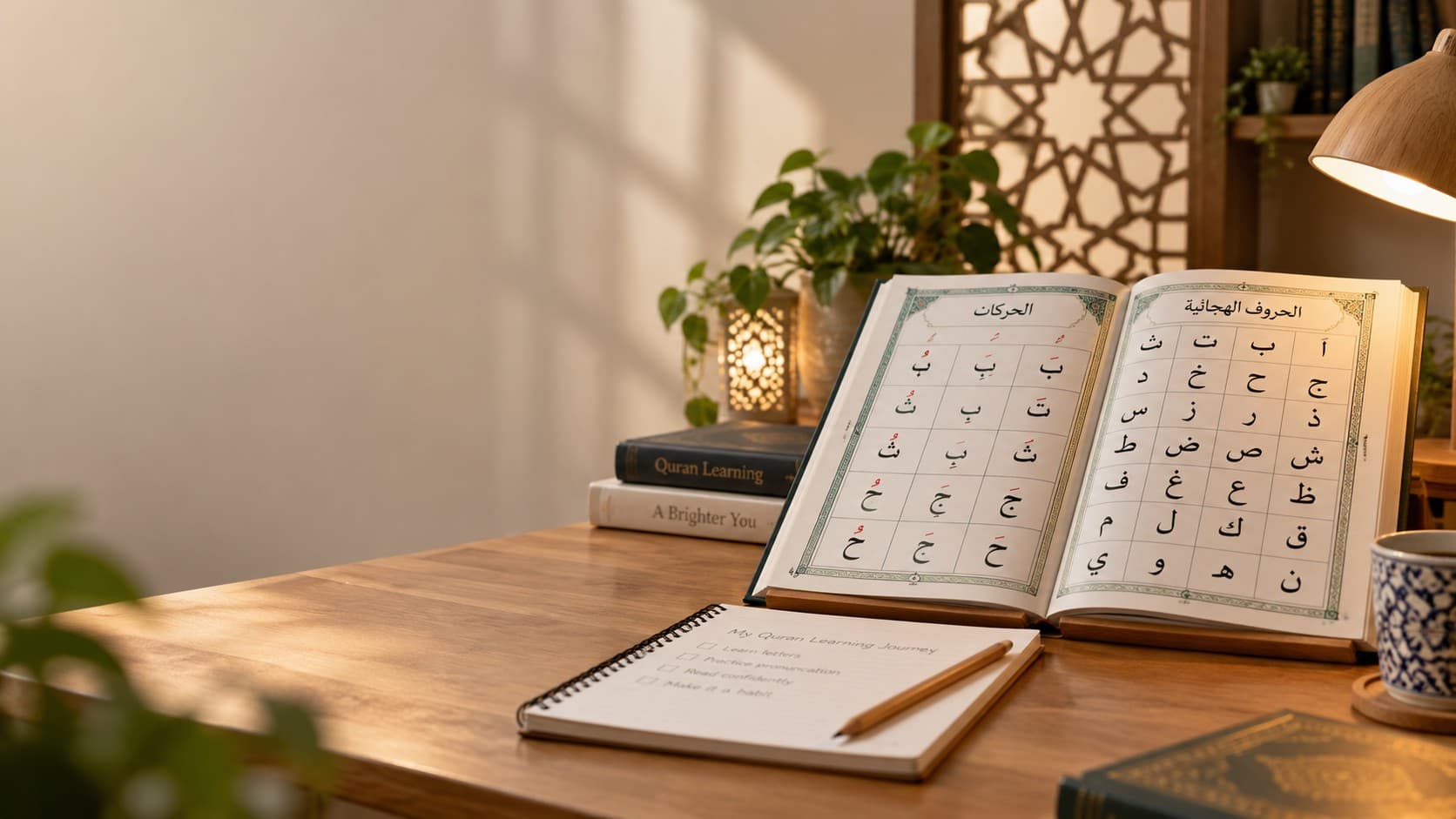
Beginners fail in a predictable way: they jump to a mushaf because it feels more “real,” then invent vowels to keep moving. The foundation is slower and less glamorous. You learn the letters, the sounds, how letters join, and how to read a short line without guessing.
If that work is not done, every later course — Tajweed, Hifz, even fluent Nazra — sits on sand. A teacher who refuses to skip it is doing you a favour.
A Simple Path From First Letters to Quran Reading
Use this as an order of work, not a calendar. Nobody owes you a finished khatam in a fixed number of weeks. You move on when the current skill is stable, not when a syllabus says you should.
| Step | What you work on | You move on when |
|---|---|---|
| 1 | Letter shapes and sounds | You recognise and pronounce letters without guessing |
| 2 | Joining, often with a primer such as Noorani Qaida | Connected words do not collapse |
| 3 | Quran reading (Nazra) | You can follow a line with correction, not from memory of last week |
| 4 | Tajweed on pages you already read | Rules have a recitation to sit on, not only names to memorise |
| 5 | Short practice between live lessons | Yesterday’s line is still in the ear before the next class |
Memorization (Hifz) is a later path. It does not replace this sequence. If reading is still guessed, the student will memorise the guess.
What Is Noorani Qaida?
Noorani Qaida is a primer used across many South Asian teaching traditions. It walks a student from single letters to joined forms, short words, and then lines that look like Quranic writing. It is not itself the Quran. It is a workshop for the skills the Quran will demand.
Fahm-ul-Quran’s Noorani Qaida course is the usual starting place when a student cannot yet read. Lessons stay one-to-one so the teacher can stop on a single letter until the sound is stable. That patience is the point of the book.
It is not the only possible primer. Other books teach the same skills. The method matters less than whether someone can hear you and refuse to let a guessed letter pass. The fuller primer guide is Noorani Qaida for beginners.
Moving From Qaida to Quran Reading
You move on when letters are recognised without a long pause, joining does not collapse, and a short line can be read with the teacher’s help rather than recited from memory of last week’s lesson. There is no badge for this. The teacher hears it.
Quran Reading (Nazra) is the next course: page by page recitation with correction. The job is fluency with accuracy — not speed for its own sake. If the student starts racing, return to a slower line. Fast and wrong is still wrong.
When Should You Start Tajweed?
You start using correct sounds from the first letter. Named Tajweed rules — madd, ghunnah, qalqalah, and the rest — usually wait until reading is steady enough that the rule has somewhere to sit. Teaching a catalogue of terms to a student who still mixes similar letters creates vocabulary without recitation.
When the time is right, Quran with Tajweed applies those rules to the pages you already read. This article does not teach those rules. For what Tajweed is (and is not), see What Is Tajweed?
How to Use a Live Lesson on This Path
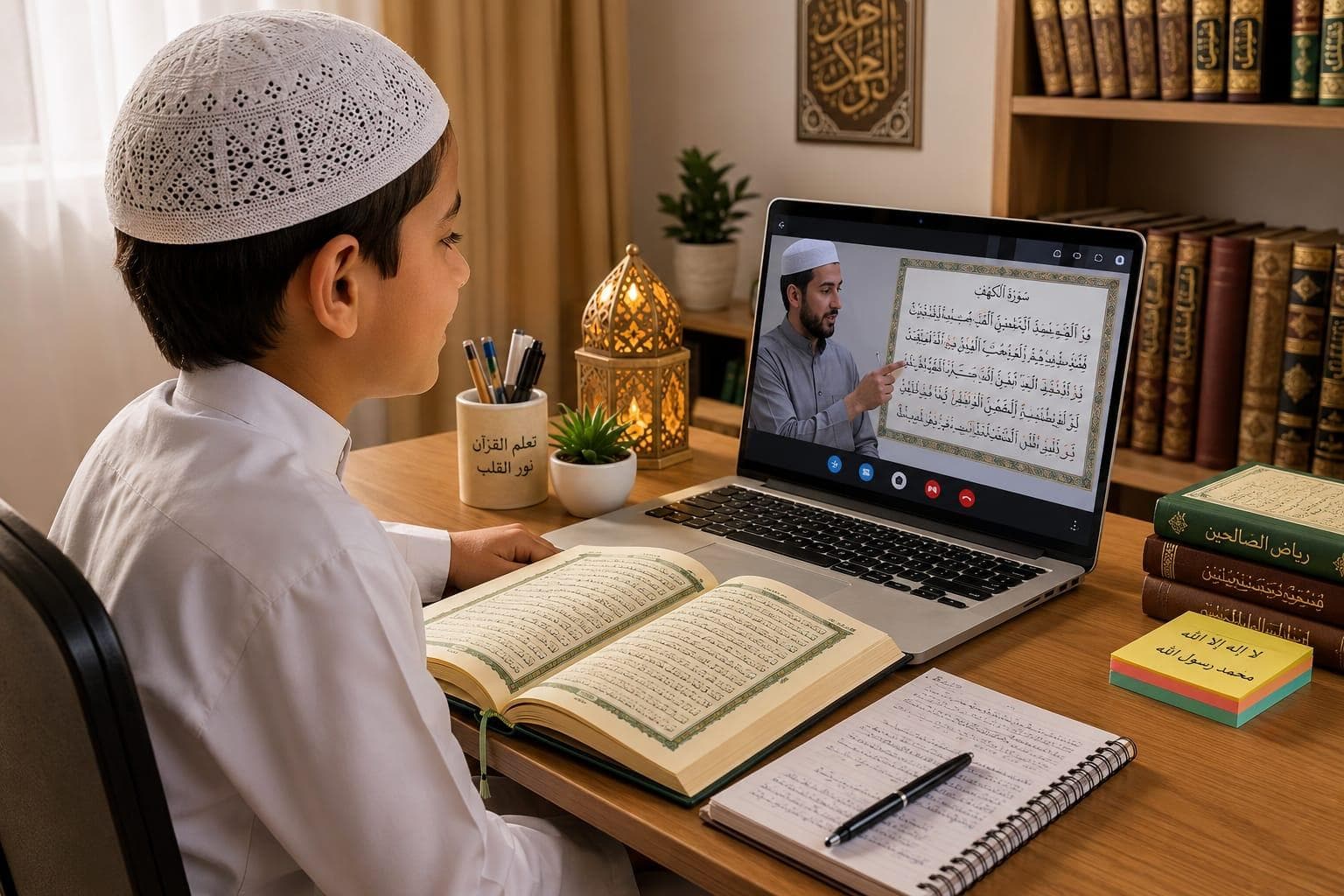
The class exists so the path above can be corrected, not so a syllabus can be announced. A typical Fahm-ul-Quran lesson is 30 minutes. The teacher hears what you prepared, corrects it, and gives a small next step. Classes run Monday to Friday on WhatsApp, Zoom, or Skype.
Use the minutes well. Have the book open before the call. Recite first; save questions for after the teacher has heard the line. If the connection drops, say so and repeat the last word rather than nodding through a lesson you did not hear. Those habits matter more than owning a second screen.
Format, equipment, and who online classes suit are covered in the classes guide linked above. You can meet the teachers before you decide. A female Quran teacher is available. Preference — male, female, or none — is something you state on the trial form, not a mystery to solve later.
What the First Weeks Usually Feel Like
The first weeks are about sound, not covering a syllabus. You may spend a whole lesson on a handful of letters that sit next to each other in the mouth. That is progress. A student who “finished” ten pages and still mixes those letters has only turned pages.
Tell the teacher what else is happening: exams, a new baby, shift work. They can keep the new material small. Hiding a chaotic week usually produces a missed class and then a guilty pause. A shorter assignment you complete is the adult way to stay in the work.
How Much Practice Should a Beginner Do?
Enough to remember the last lesson before the next one. For a child, that may be ten quiet minutes on a weekday. For an adult, it may be the same page recited twice after work. Long Saturday marathons that never happen are not a plan.
There is no academy-wide daily schedule that fits every student. Sleep, school, and energy differ. Ask the teacher what to repeat before the next class, then protect that small slot. Consistency beats intensity you cannot repeat. What to do in those minutes is spelled out in how to practise Quran recitation at home. How long the whole path takes is a different question — and has no honest single number — in how long it takes to learn Quran online.
Common Beginner Mistakes
- Skipping letters that look “close enough”
- Memorizing a line instead of reading it, then freezing on a new page
- Practising only inside the class and hoping the teacher will carry the rest
- Changing teachers every fortnight before a habit can form
- Comparing a child’s week to a cousin’s Instagram progress
Another quiet mistake is collecting apps and colour-coded Tajweed copies while the student still cannot hold a simple noon. Tools help after the ear is working. They do not replace it. Typical slips, and how to work on them, are in common Quran reading mistakes beginners make.
How Parents Can Support Children
Sit nearby for the first classes. Keep the device charged. Repeat the teacher’s exact homework — not a longer homework you invented because you felt anxious. Praise effort you can see (“you sat for the whole lesson”) more than speed you wish you could see.
If the child is tired, say so. A teacher can shorten the new work. A parent who hides exhaustion and then argues through the lesson teaches the child that Quran time is a battle. A fuller parent role — without taking over the class — is in how parents can support a child’s online Quran lessons.
How Adults Can Stay Consistent
Attach the class to something that already happens: after Fajr, after the school run, before the last email of the day. Tell the teacher your real week, not an ideal week. Missing a day is ordinary; missing the next two because you felt ashamed is how adults stop.
Sisters studying after family work often need the same honesty. A 30-minute weekday slot you keep is worth more than a plan that assumes you have evenings free. If you are starting from letters, or restarting after years away, the adult roadmap is how to learn Quran from scratch as an adult. This page stays the shared beginner path.
When to Ask a Teacher for Help
Ask when a letter will not settle, when you dread a particular page, or when you have been “reviewing” the same line for weeks without it getting easier. Those are teaching problems, not character problems. A live teacher can change the drill. A silent student cannot.
If you are still choosing who that teacher should be, use questions to ask before you choose an online Quran teacher. Do not treat this path article as a hiring checklist.
If You Want This Path With Someone Listening
Learning Quran online as a beginner is straightforward if you refuse shortcuts. Start with a foundation such as Noorani Qaida, move into Quran reading when the teacher hears that you are ready, add Tajweed when rules have a recitation to live in, and practise a little between live classes. If you want that path with a person listening, request a free 3-day trial — 30 minutes, completely free, and treated as a request rather than instant enrolment.