What Is Tajweed? A Beginner's Guide to Reading the Quran Correctly
What Tajweed means, why it matters for recitation, which areas beginners usually meet first, and how one-to-one online classes help.
8 September 2026 · 10 min read · Fahm-ul-Quran Online Quran Academy
“Learn Quran with Tajweed” usually means one thing: the student wants to recite as the words are meant to be recited, not as a hurried approximation. Tajweed is the craft of that accuracy. It is not a sticker you earn after a weekend course, and it is not a short list you can finish by memorizing names.
This guide explains what Tajweed means, why it matters, which areas beginners often meet first, and how a live teacher can correct it. It is an introduction, not a complete curriculum. How to practise those sounds at home is in how to learn Quran with Tajweed at home. How to improve recitation more broadly — pace, recording, one weakness at a time — is in how to improve Quran recitation. It is not a class-format explainer, and it is not the full beginner path from letters to pages — those live in online Quran classes for kids and adults and how to learn Quran online.
What Does Tajweed Mean?
In ordinary Arabic usage, tajweed is about making something excellent or doing it well. In Quran recitation it names the body of rules that describe how letters are pronounced, how they meet each other, and how the recitation is measured. Teachers use it as a practical standard: each letter from its place, with its qualities, in the length the recitation requires.
You do not need to speak Arabic fluently to begin. You do need to accept that some sounds in the Quran do not exist in English or Urdu in the same way, and that the ear has to be trained.
What Tajweed Is Not
- Not a certificate. Finishing a booklet does not mean the mouth has learned the sound.
- Not the same as a beautiful voice or a reciter’s melody. Melody on unclear letters is still unclear recitation.
- Not a substitute for being able to follow the line. If joining still collapses, named rules have nowhere to sit.
- Not a 30-day finish line. Improvement is heard on the same page next week, not announced as a package.
Tajweed and Ordinary Quran Reading
Quran reading (Nazra) is the work of following the text: letters, joining, and moving through a line. Tajweed is how those letters are meant to be recited — place, quality, and measure. A student can “get through” a page and still merge two letters. That is reading without much Tajweed, not proof that Tajweed is unnecessary.
The two are not enemies. Correct sounds begin with the first letter. Named rules usually wait until the line can carry them. That timing belongs to the learning path, not to this definition.
Why Does Tajweed Matter?
Small sound changes can turn one word into another, or flatten a meaning the recitation is meant to carry. Even when the listener still “recognises” the verse, careless recitation becomes a habit that is hard to unwind later — especially if the student then memorizes it.
Tajweed is also a form of respect: giving each letter its due rather than rushing to finish a page. That is a moral reason, not a technical one, and it is why families ask for Tajweed even when the student can already “get through” a surah. This article does not issue a legal ruling on every recitation. It describes why teachers take the sounds seriously.
Tajweed and Measured Recitation
The Quran itself asks for recitation that is measured, not snatched:
“…and recite the Quran with measured recitation.”
That verse is not a lesson plan. It is a direction of travel: recite in a measured way. Tajweed is how teachers have described that carefulness in detail. We will not stretch the verse into a tafsir it does not offer here.
If you can already read pages and want systematic correction, the Quran with Tajweed course is the academy path for that work. If reading itself is still new, Quran Reading (Nazra) is usually the better first step.
Common Areas Beginners Learn
A teacher does not empty the whole science onto a first-week student. They listen, then choose the next correction that will actually hold. The areas below are common entry points. They are not the full map. Tajweed includes many further rules of merging, noon and meem, stopping, and letter qualities that this article does not pretend to teach.
Makharij and Pronunciation
Makharij are the exit points of letters — throat, tongue, lips, and the nasal passage. Beginners often collapse letters that share a neighbourhood: ha and ḥa, seen and sheen, daal and ḍaad. A teacher will have you watch the mouth and repeat a single letter until the place is right. This is slow on purpose. A fuller beginner guide to articulation points is in how to learn the Makharij of Quran letters. Similar-letter habits are also covered, as reading mistakes rather than as a rulebook, in common Quran reading mistakes beginners make.
Ghunnah
Ghunnah is a nasal sound that belongs to certain letters and rules, notably noon and meem in specified cases. Beginners either skip it entirely or hold a hum on letters that should be clean. You learn it by hearing a model, then matching the length — not by circling the word in a colouring book and hoping the nose cooperates.
Madd
Madd is elongation: some vowels are held for a measured count. New students either clip them short or stretch every alif they see. Counting on fingers can help at first. The aim is a stable habit, not a performance of counting out loud forever.
Qalqalah
Qalqalah is a slight echo on particular letters when they are saakin (without a vowel), especially when stopping. Beginners either bounce every letter or flatten these into silence. The letters commonly taught for this are qāf, ṭā, bā, jīm, and dāl. The teacher demonstrates on a word you already know, then listens to you.
Later — not necessarily in the first month — you will also meet rules for noon and meem, how letters merge, and how to stop on a word without breaking the meaning. Each of those is its own field of listening. Naming them here is enough; practising them belongs in a class, on a specific line.
Common Beginner Mistakes
- Collecting rule names faster than they can be applied on a page
- Copying a famous reciter’s melody while the letters underneath are still unclear
- Ignoring similar letters because “people still understand me”
- Starting Hifz on recitation that has not been checked
- Treating a colour-coded Quran as a substitute for a listening teacher
Can You Learn Tajweed Online?
Yes, when the class is live and the teacher can hear you clearly. A delayed recording, or a group in which you recite once in forty minutes, will teach you less than a 30-minute one-to-one slot. Online Tajweed fails when the microphone is poor or the student whispers. It works when you recite at a normal voice and accept being stopped.
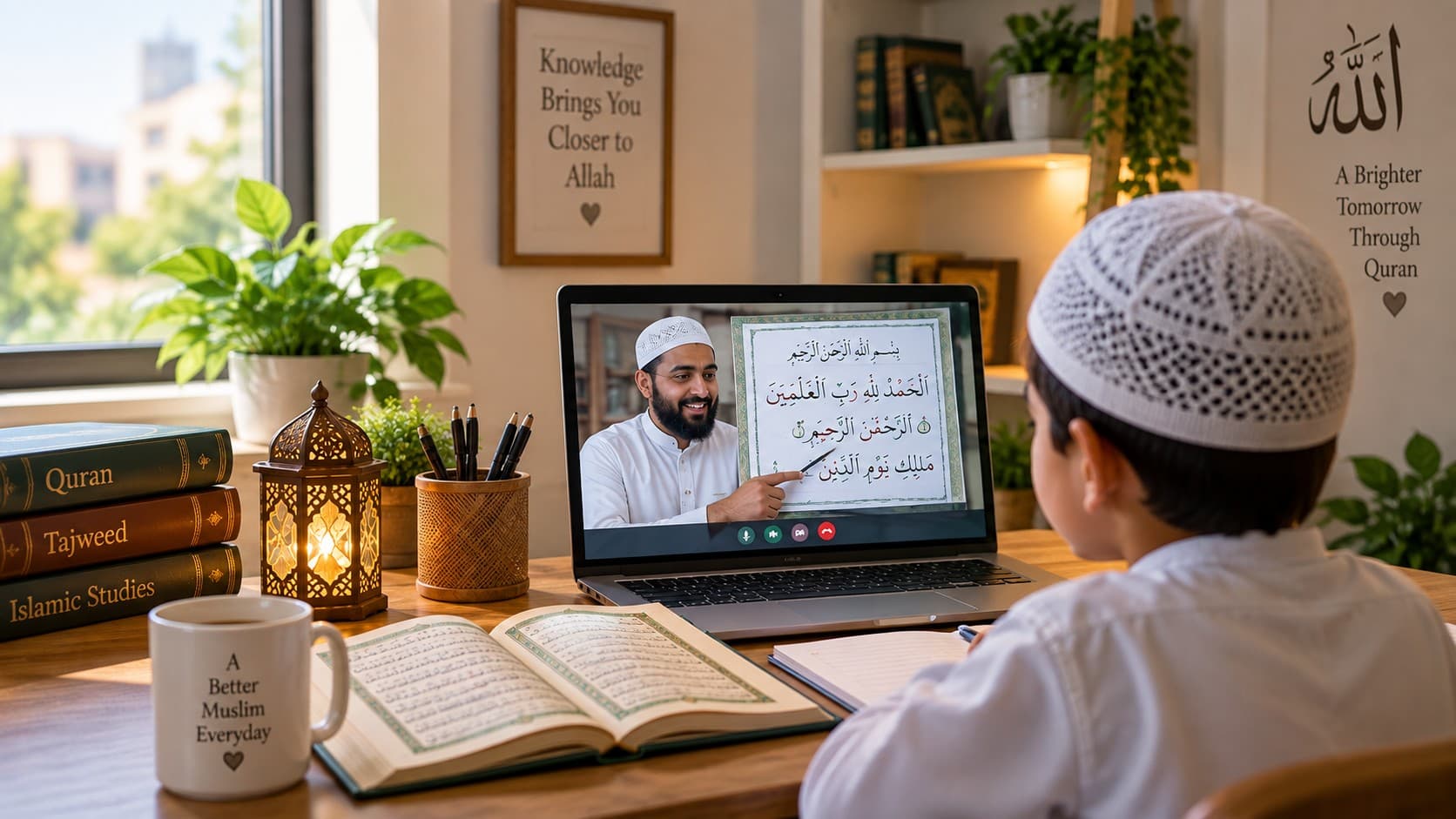
At Fahm-ul-Quran that work happens in live one-to-one classes, Monday to Friday, 30 minutes, on WhatsApp, Zoom, or Skype. The teacher hears a passage, isolates a problem, models the sound, and has you repeat. You can see the teachers; a female Quran teacher is available. How those classes are set up for children and adults is not repeated here — see the classes guide linked above.
How a Teacher Usually Sequences Corrections
A careful teacher does not mark every error on the first page. They pick the mistake that will unlock the next line — often a letter place — and leave a milder length error for later. Students sometimes feel cheated (“you did not mention my madd”). Sequencing is not neglect. Two corrections you can hold are worth twelve you forget by the door.
If you want a second opinion, recite the same short passage in the next class without being told where to start. What survives without a reminder is what you have actually learned. Between classes, repeat only what was assigned; home practice should review the last correction, not invent a new syllabus.
How to Begin Learning Tajweed
If letters are still unstable, begin with reading foundations rather than a Tajweed syllabus. If you can already read, ask a teacher to assess a short passage and name the first two corrections — not the next forty rules. Practise those until they appear without being reminded, then add the next.
That is slower to advertise than “complete Tajweed in 30 days.” It is how recitation actually improves. Where this sits in the wider beginner sequence is in how to learn Quran online. Adults restarting from letters should use that path, or the adult-from-scratch guide, before treating this page as week-one homework.
If the next question is memorization, store only what has been checked. Why that matters for Hifz is in how to memorize the Quran — this article stays with what Tajweed is.
If You Want the Sounds Corrected, Not Only Named
Tajweed is the disciplined way of giving Quranic letters their pronunciation and measure. You can begin to learn Quran with Tajweed online if a teacher hears you live and you are willing to repeat unglamorous sounds. Do not expect a short article — or a colour chart — to replace that work. When you want a person on the other side of the page, request a free 3-day trial: 30 minutes, completely free, offered as a request rather than instant enrolment.