Quranic Arabic for Beginners: How to Start Understanding Quranic Words
A beginner does not need conversational fluency first. What Quranic Arabic is, how it differs from spoken Arabic, which words to learn, and a simple daily path from reading to understanding.
20 September 2026 · 14 min read · Fahm-ul-Quran Online Quran Academy
A person can finish a page of the Quran, hear every letter, and still not know what any of it said. That is not a failure of sincerity. Reading and understanding are different skills. Many adults assume the only next step is “learn Arabic” — meaning years of conversation, newspapers, and grammar books — before they are allowed to recognise a Quranic word.
That assumption delays the work. Quranic Arabic can be started as a narrow, practical study: the words and patterns that keep returning in the Quran. You do not need street fluency first. You also do not jump from a first word list to a personal tafsir. This page is the middle path — reading to vocabulary to basic language sense to fuller understanding — and how a beginner can walk it without inventing a second Arabic degree.
If you still cannot follow the written line, start with how to read the Quran correctly. If you already read and want a method for translation and explanation, use how to learn Quran with meaning. For a sit-down study loop — goal, passage, notes, review — use how to study the Quran for beginners. This article is the language layer between those paths.
What Is Quranic Arabic?
Quranic Arabic is the Arabic of the Quran: its vocabulary, sentence habits, and the way words are built. It is a register of classical Arabic. It is not a secret dialect, and it is not “whatever Arabic people speak at the market.”
For a beginner, the useful definition is narrower still. You are not trying to discuss the weather. You are trying to recognise recurring words — Lord, said, those who, indeed, mercy — and to see how a short verse is put together. That recognition is language work. It is not yet Tafsir, and it is not yet conversational fluency.
What “understanding the Quran” includes, beyond words, is already named in What Is Fahm ul Quran?. Quranic Arabic is one tool in that work. It is not the whole of it.
Do You Need to Learn Arabic Fluently to Understand the Quran?
No. Fluency is not an entrance ticket. A reliable translation already opens meaning in a language you read. High-frequency Quranic vocabulary then lets you notice the same words when they return — in Salah, in a short surah, on a page you have recited for years.
Fluency still has a place. A fluent reader hears emphasis, word order, and connections that any translation has to flatten. That is a later gain. Waiting for it before you learn rabb or qala is how people stay stuck on the same recitation for another decade.
You also do not need to “understand the Quran without translation” as a first goal. Vocabulary reduces how often you reach for a rendering. It does not retire translation, and it does not replace explanation when a verse is legal, disputed, or tied to a context you do not have. The verse-level method for readers who do not yet know Arabic is in how to understand Quran verses when you don't know Arabic.
Quranic Arabic vs Modern Standard Arabic vs Spoken Arabic
“Arabic” is not one classroom. Mixing the three kinds is why beginners either enrol in a conversation course they do not need yet, or abandon Quranic study because the first dialogue lesson felt irrelevant.
| Kind | Where you meet it | What it is for |
|---|---|---|
| Spoken Arabic | Homes, streets, and regional dialects — Egyptian, Levantine, Gulf, Maghrebi, and others. | Daily conversation. Vocabulary and pronunciation shift by country. Useful for life; not the first tool for the mushaf. |
| Modern Standard Arabic (MSA) | News, formal writing, many school textbooks. | Shared formal Arabic after the classical period. Related to Quranic Arabic, but not identical in vocabulary, style, or aims. |
| Quranic / classical Arabic | The Quran, and much of the earlier literary and religious corpus. | Recognising Quranic words and structures. The beginner’s target when the goal is understanding the Book. |
A word you learn for a Cairo taxi will not automatically appear in Al-Fatihah. A Quranic particle you learn this week may barely help you order lunch. Both kinds of Arabic are real. They are not the same syllabus. If your aim is the Quran, start with Quranic words in Quranic sentences. Conversation can wait unless you also want it for its own sake.
What Should a Beginner Learn First?
Sequence matters more than enthusiasm. Grammar piled on unread letters collapses. Word lists piled on unread letters become noise. A workable order looks like this.
- Arabic script recognition, if the letters are still new.
- Enough reading confidence to follow a short line.
- High-frequency Quranic vocabulary from passages you already recite.
- Basic word patterns — how a word looks when it is a verb, a name, a command.
- Root-word awareness: related words that share three letters.
- A few grammar ideas, only as they explain the line in front of you.
- The same words studied again inside the verse, not only on a flashcard.
- A reliable translation of that same verse, compared after you have looked at the Arabic.
- Gradually longer passages, still short enough to review.
Script, if you need it
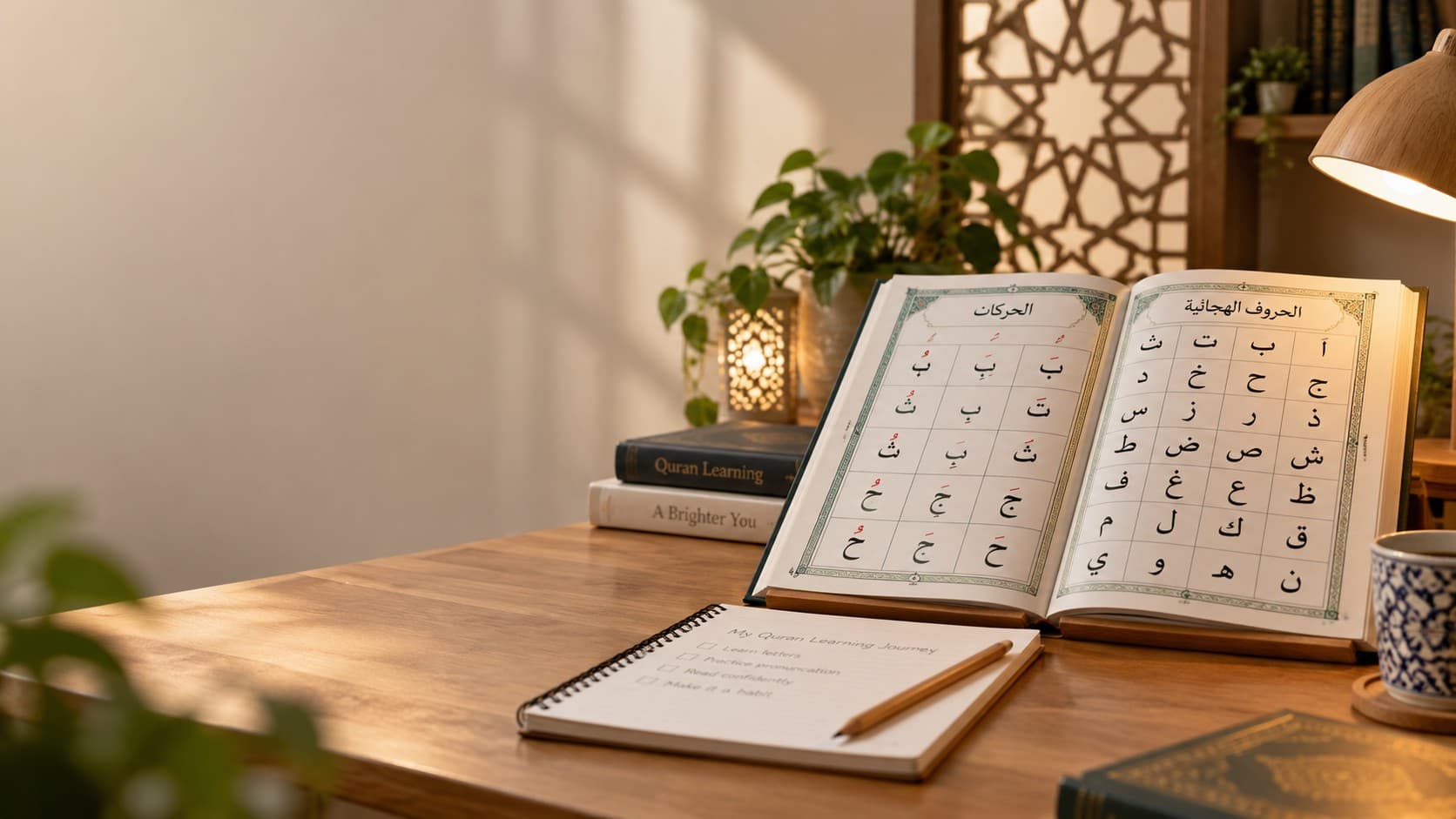
If isolated letters still swap places, vocabulary can wait. Noorani Qaida is the usual door. You are not “behind.” You are on the first stair.
Reading confidence
You do not need racing fluency. You need to stay on the line without guessing every second word. That is enough to attach meaning to what you see.
Vocabulary before heavy grammar
Learn the words that keep returning before you learn the names of every case ending. A beginner who knows a dozen frequent words in Al-Fatihah has more to work with than a beginner who can define i‘rab and still cannot spot rabb.
Patterns and roots, then light grammar
Once a handful of words are stable, notice how they change shape, and that many Quranic words share a three-letter root. Grammar then explains the line you are already reading. It is not a separate mountain you climb before you are allowed to open the mushaf.
Why Learning Common Quranic Words Helps
The Quran repeats. Particles, pronouns, and a relatively small set of content words come back across surahs. High-frequency vocabulary helps a learner recognise those returning pieces. It does not unlock a fixed percentage of the Book, and it is not a promise that “X words equal understanding the Quran.”
What it does is practical. The word you learned in a short surah shows up in Salah. The same verb appears in a story later. The page stops being an unbroken ribbon of unfamiliar shapes. You still need translation and, often, explanation. You are no longer starting from zero on every line. A curated beginner set — with meanings and how to study them — is in common Arabic words in the Quran.
Common examples a teacher will keep pointing to — without turning them into a magic list — include rabb (Lord), forms related to mercy such as al-Rahman and al-Raheem, qala (he said), and frequent function words such as inna and alladhina(those who). Learn them where they sit in a verse you already know. Do not collect them as trophies.
How Root Words Help Beginners
Many Arabic words are built from a three-letter root. Related meanings cluster around those letters. The root r-ḥ-m is the usual classroom example: it sits behind words we render as mercy, the Most Merciful, the Especially Merciful. Once you have seen the cluster, a new word from the same family is less of a stranger.
Roots are a map, not a decoder ring. Not every derived word means what a beginner guesses from the root alone. Context and established usage decide. Use roots to notice family resemblance. Do not invent a meaning because three letters looked familiar.
How to Learn Quranic Vocabulary Without Memorizing Random Word Lists
Isolated lists feel productive. They rarely stick. A word learned beside the verse you will recite tomorrow is still there next week. A word learned from a 200-item sheet is gone by Thursday.
- Pick one short passage — Al-Fatihah, a short surah, or a few lines you already read.
- Choose three to five words from that passage, not fifteen.
- Note a simple gloss in your own language, then read the Arabic again before you open a full translation.
- Compare with a reliable translation of the same lines. Adjust the gloss if you flattened something.
- The next day, start by finding yesterday’s words in the same verses. Only then add new ones.
That is vocabulary in context. The list, if you keep one, is a review tool for words that already have a home in a verse. It is not the course.
A Simple 20-Minute Daily Quranic Arabic Routine
Twenty minutes is enough if it is the same kind of twenty minutes. Racing through a new surah every night is not a routine. It is tourism.
- Minutes 1–5. Recite or read yesterday’s passage. Point to the words you already named.
- Minutes 6–13. Take three to five new words from the same passage or the next two lines. Write a short gloss. Say the Arabic aloud.
- Minutes 14–18. Read a reliable translation of those lines. Notice what your gloss missed.
- Minutes 19–20. Write one note: a root you spotted, a word that returned, or a question for a teacher.
Miss a day without rebuilding the whole plan. Return to the same passage. New pages without review become a blur of half-known words.
A Beginner’s 4-Stage Learning Path
Stages overlap. You do not graduate with a certificate. You do notice when the work has changed.
Stage 1 — Recognition
Letters are stable. A short line can be followed. You are not yet asking every word what it means. If this stage is unfinished, stay here. The beginner reading path is in what a beginner should learn first.
Stage 2 — Vocabulary
Frequent words in passages you already recite start to light up. Salah becomes less of a sound-only exercise. You still use a translation. You use it after looking at the Arabic, not instead of looking.
Stage 3 — Patterns and basic grammar
You notice a verb changing person, a noun looking definite, a particle that always seems to start a clause. A teacher or a careful book names those patterns as they appear. You do not pause the mushaf for a year of isolated grammar drills.
Stage 4 — Understanding verses in context
You read a short passage as a passage: Arabic, known words, translation, then explanation where the sense is not clear. That is the method in the meaning guide, now with more of the Arabic doing some of the work. It is still not a licence to issue Tafsir.
Common Mistakes Beginners Make
- Trying to learn all Arabic at once. Dialect, MSA, and Quranic study in the same month usually means none of them settle.
- Memorising isolated words without a verse. The card is remembered. The page is not.
- Focusing only on translation. Useful as a check. Weak as the only contact with the Arabic.
- Jumping into advanced grammar too early. Case names without known words become a second foreign language on top of the first.
- Expecting instant comprehension. Recognition arrives in pieces. Whole-page understanding arrives later, and unevenly.
- Confusing vocabulary with Tafsir. Knowing that a word is often rendered “those who” is not an interpretation of the verse.
- Assuming Quranic Arabic is conversational fluency. You can grow in the mushaf and still be quiet in a spoken dialect. That is not a failure of the Quranic work.
Quranic Arabic, Translation, and Tafsir: How They Work Together
Keep the jobs separate. The longer comparison of translation and Tafsir is in Quran translation vs Tafsir. What Tafsir is, beyond that comparison, is in What Is Quranic Tafsir?. Here is where language study sits among them.
| Work | What it is | What it is not |
|---|---|---|
| Reading | Recognising and reciting the Arabic text. | Not yet knowing what the line means. |
| Translation | Carrying the meaning into another language. | Not the Arabic original, and not a full scholarly explanation. |
| Quranic Arabic | Learning the vocabulary and patterns of the Quran so more of the line is visible in Arabic. | Not conversational fluency, and not Tafsir. |
| Tafsir | Scholarly explanation using language, context, and established methods. | Not a first gloss, and not a personal impression announced as interpretation. |
This article is not Tafsir. It does not settle disputed verses. A word you have learned correctly still sits inside a passage that may need a qualified explanation. Language study makes that explanation easier to follow. It does not replace it.
When Should You Learn Quranic Arabic With a Teacher?
Self-study is enough to start a notebook and a short daily passage. A teacher becomes useful when the work stops moving, or when you cannot tell if a guess is a real pattern or a coincidence.
- Two words look related and you cannot check the root safely.
- Grammar explanations in a book do not match the line you are reading.
- You want reading and meaning corrected in the same sitting.
- You keep skipping review because there is no one to answer to.
Live one-to-one study is one way to keep the sequence honest — reading first if needed, then words in context, then explanation. Adults who want understanding in Urdu, rather than an advanced tafsir programme, can look at the Fahm-ul-Quran course. A trial is a request, not instant enrolment. A recitation teacher is not automatically a language teacher, and a language teacher is not automatically a mufassir.
Adults starting later in life are not a special exception. The same order applies; the week is just tighter. Learning Quran from scratch as an adult covers that pacing. Add Quranic words only as fast as review can hold them.