Quran Reading for Adults: How to Start If You Cannot Read Arabic
Where an adult who cannot yet read Arabic should start: letters, harakat, joining, Noorani Qaida, and when Tajweed can wait — without treating spoken Arabic as a gate.
19 September 2026 · 13 min read · Fahm-ul-Quran Online Quran Academy
Quran reading for adults often begins with a quieter problem than “which course should I join?” The adult already wants to read. What they cannot do yet is decode the script: the letters are unfamiliar, or they come slowly, or a childhood page has gone thin. The useful question is not whether it is too late. It is where the first lesson should actually start.
This page is about that literacy problem — starting Quran reading when you cannot yet read Arabic, or can only pick through it. The wider adult journey (routine, first month, confidence) is in how to learn Quran from scratch as an adult. Fitting lessons around a job is in how to learn Quran online for busy adults. Those are different articles. This one stays with the script.
Can Adults Learn to Read the Quran From Scratch?
Yes. An adult who cannot currently read Arabic can begin with the letters and their sounds, then move through vowel marks, joining, short words, Quranic lines, cleaner pronunciation, and — when the line can carry it — Tajweed. How long each layer takes depends on the learner. There is no honest fixed calendar.
Do I Need to Know Arabic Before I Learn to Read Quran?
You do not need conversational Arabic to begin Quran reading. Spoken fluency, grammar, and vocabulary are a different subject from recognising written letters and sounding them out. Mixing those jobs is how adults delay the first page.
Reading
Recognising Arabic letters on the line and pronouncing them as written — including the short vowels marked on Quranic text.
Understanding
Knowing what the words and verses mean. That can grow later, through translation, tafsir, or Arabic study. It is not a gate you must pass before letter work.
Arabic language study
Vocabulary, grammar, and conversation. Useful for meaning. Not required to start decoding the Mushaf.
Recitation is the act of reading the Quran aloud. Tajweed is how those letters are meant to be recited. You can begin reading without finishing a language course. You should not pretend that reading the script is the same as understanding the verse.
Where Should an Adult Start?
The sequence below is a common teaching path, not the only valid curriculum. A teacher who hears you may skip a step you already hold, or stay longer on one you do not.
Step 1 — Letter recognition
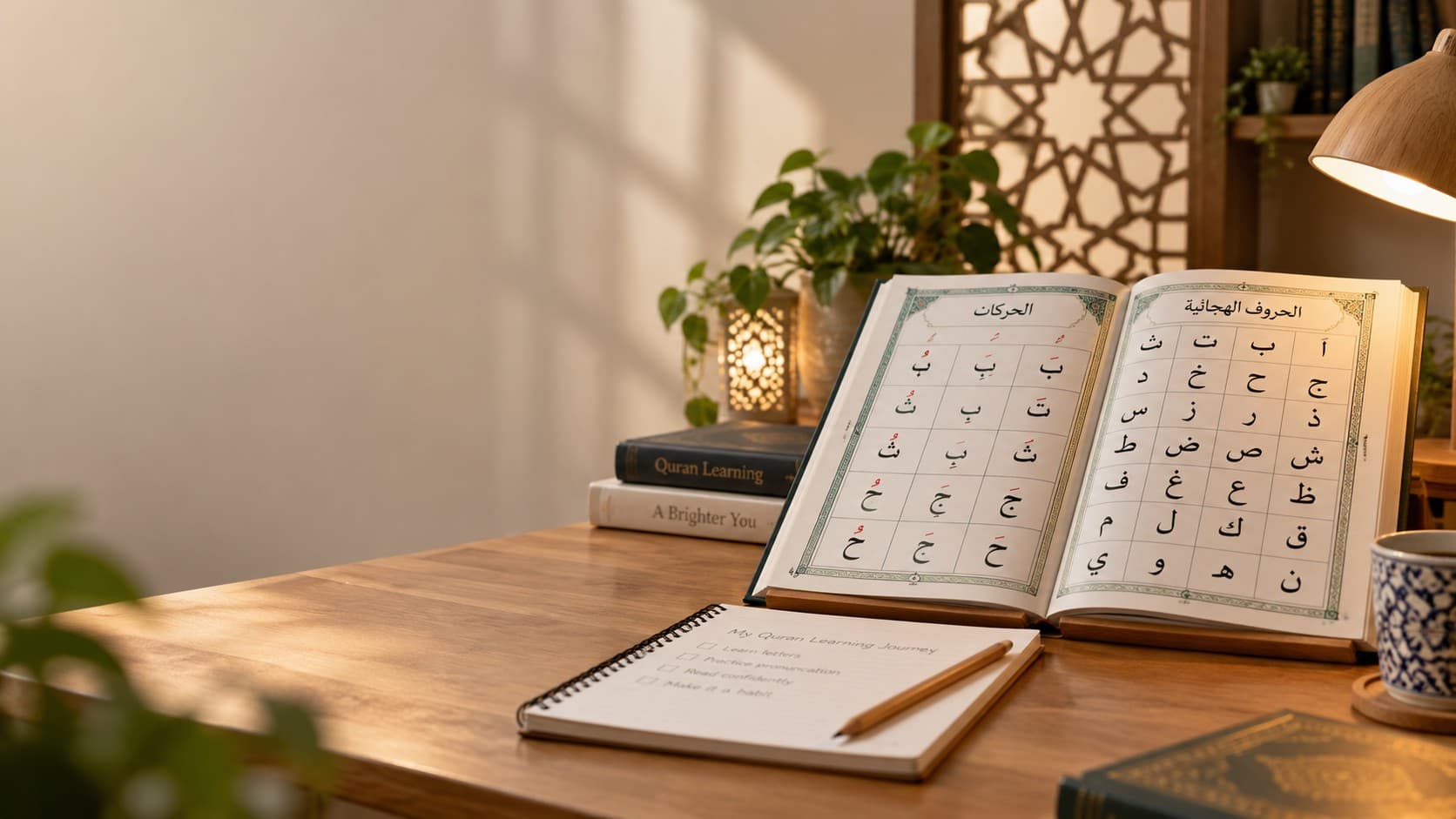
Learn the Arabic letters and how their shapes change at the beginning, middle, and end of a word.
Step 2 — Letter sounds
Produce each letter from its place. English “equivalents” are only a temporary hint. They are not the letter.
Step 3 — Harakat
The basic short vowels: fathah (a short “a” sound), kasrah (a short “i”), and dammah (a short “u”). These marks tell you how to voice the letter. Without them, guessing begins.
Step 4 — Joining letters
Isolated letters are not yet reading. Connected forms are the script you will meet on a Quranic line.
Step 5 — Sukoon and shaddah
Sukoon marks a letter with no vowel. Shaddah marks a doubled letter. Introduce them when joining is already stable, not as a first-week pile.
Step 6 — Longer combinations
Move from drills to words and short sequences you can finish without inventing vowels.
Step 7 — Quranic text
Short, actual Quranic phrases, slowly. How that line is built is in how to read the Quran correctly.
Step 8 — Makharij
Refine articulation so similar letters stay distinct.
Step 9 — Tajweed
Structured rules once the foundation can carry a correction. Named beginner cases are in Tajweed rules for beginners.
What Is Noorani Qaida?
Noorani Qaida is a beginner primer. It introduces Arabic letters, sounds, joining, and short reading exercises in a graded order so a student is not dropped onto a Mushaf page on day one. Many adult beginners use it, or a similar book, because the steps are small enough to repeat.
It is not a requirement that every adult open this exact book. It is a common tool for the literacy work this article describes. What the primer contains, and who actually needs it, is in Noorani Qaida for beginners.
What If I Already Know Some Arabic Letters?
Complete beginner
Start from recognition and sound. Do not open long Quranic pages to feel that the work is “real.”
Partial familiarity
Have someone hear which letters you actually know, and which only look familiar. A half-remembered alphabet still needs the gaps named.
You can read slowly
Keep reading, but prioritise accuracy and joining. Speed comes after the line is true.
You can read, with many mistakes
The job is often Makharij and early Tajweed, not restarting the alphabet — unless the foundation is actually missing.
What If I Learned Quran as a Child and Forgot?
Adults who return sometimes still hold fragments: a few letters, a short surah by ear, the habit of opening a Mushaf. That is not the same as a complete beginner, and it is not fluency. Reassess what you can do today. You may not need page one of a primer. You may need the first unstable join, or the letters that always collapse. Starting “from the beginning” for pride wastes months you do not have to spend.
How Long Does Quran Reading Take for an Adult?
There is no honest number of days or months that fits every adult. Time depends on starting level, prior exposure, practice frequency, whether anyone hears you, which sounds are new to your language, consistency, and whether the goal is “I can sound out a line” or “I can read a page cleanly.”
Think in stages, not a countdown:
- Foundation — letters and basic combinations
- Early reading — simple connected forms
- Quran reading — short passages
- Developing fluency — longer lines, fewer invented pauses
- Tajweed refinement — pronunciation and rules on text you can already follow
A broader reading-time question — Qaida to pages online — is in how long it takes to learn Quran online.
How Much Should an Adult Practise?
These are example lengths, not religious requirements. Consistency beats an impressive plan you abandon.
- 10–15 minutes — very limited time; keep it focused
- 20–30 minutes — a common regular slot
- Longer — only if the ear stays alert
A 20-Minute Adult Beginner Routine
Adapt the minutes. Keep one job per block.
- 5 minutes: review letters or joins from yesterday
- 5 minutes: pronunciation of the letters that still fail
- 5 minutes: beginner material — primer or short words
- 5 minutes: mark what to open tomorrow
A 30-Minute Routine
- 5 minutes: review
- 10 minutes: new primer or joining work
- 10 minutes: short Quranic reading or pronunciation on those words
- 5 minutes: correction and a note for the next lesson
A teacher can shift the balance. Daily habit design — if the problem is consistency rather than literacy — is in daily Quran reading practice. Adult routine design for missed days, weekly structure, and work/family anchors is in Quran study routine for adults.
Should Adults Learn Tajweed Immediately?
Build enough reading that a correction has somewhere to sit. Do not wait for “perfect” reading before any Tajweed appears. A teacher can introduce place and a simple rule as soon as the mouth can hold it. Tajweed is not a prize for advanced students only. It is also not a chart you memorise before you can join two letters. Home methods sit in how to learn Quran with Tajweed at home.
Why Makharij Matter When You Are Still Learning to Read
Reading is not only recognising a shape. If two letters leave from the wrong place, the word you think you read is not the word on the line. Adults whose first language lacks some Arabic sounds need more repetition, not an English substitute. How to practise the places is in how to learn Makharij of Quran letters.
Common Challenges Adult Learners Face
- embarrassment about starting late
- letters that will not stay in memory
- similar letters that keep swapping
- slow reading that feels humiliating
- vowel marks that still look optional
- sounds the mouth has never made
- practice that keeps slipping
- a calendar with no spare hour
- fear of being heard making a mistake
- comparing yourself with someone who grew up reading
Not every adult meets all of these. The ones that appear are ordinary. They are not proof that the skill is closed.
How to Work With Those Challenges
- Letters will not stick: fewer letters, more repetition, the same day they were taught
- Similar letters: practise the pair together until the places differ
- Slow reading: keep accuracy; do not add pages to look faster
- Pronunciation: get a live ear — you cannot hear your own makhraj reliably
- Little time: keep the 15-minute version
- Forgetting last week: start every session with yesterday’s line
- Fear of mistakes: treat correction as the lesson, not as a verdict
Can Adults Learn Quran Reading Online?
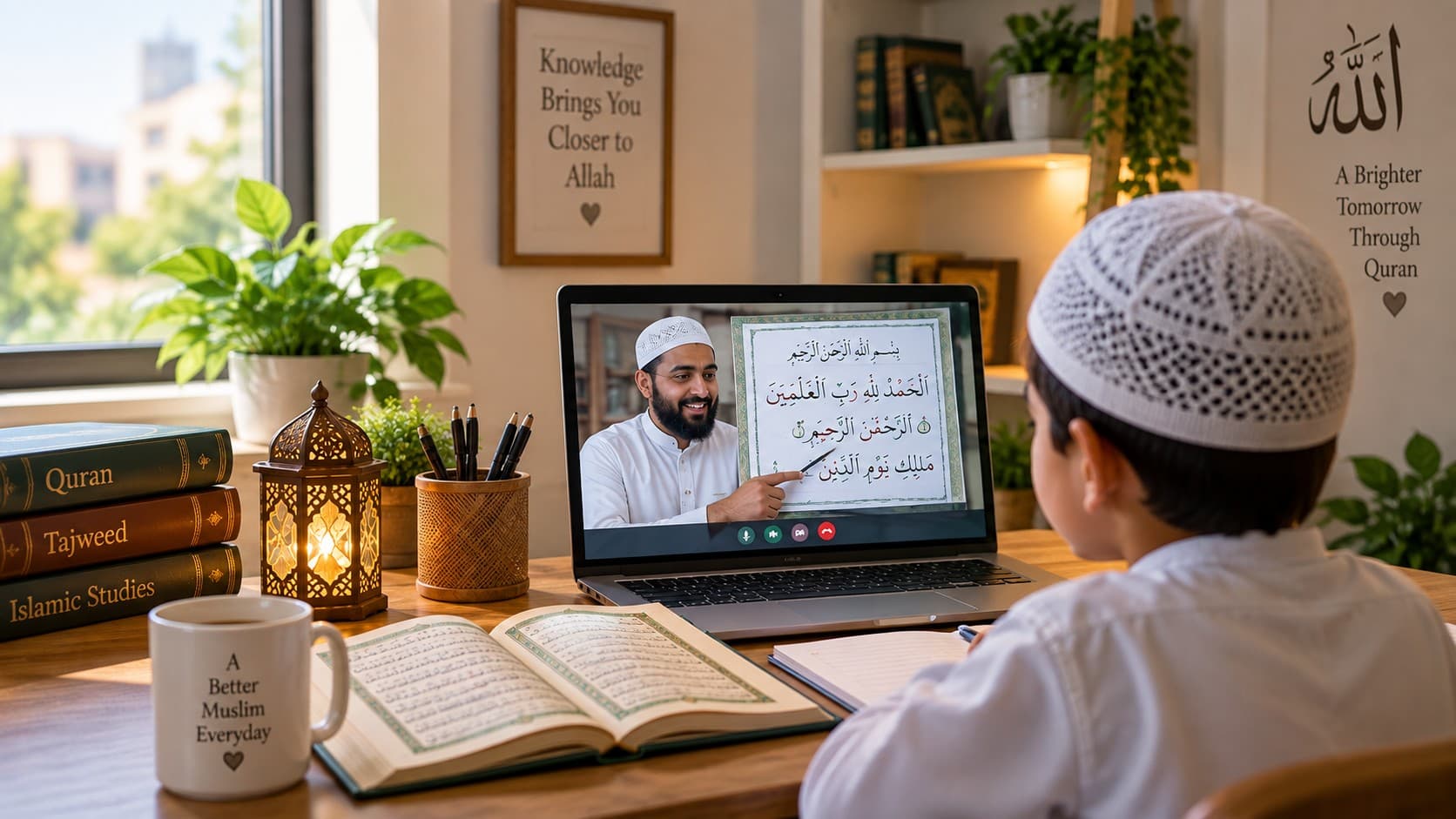
Yes, when the class is live and the teacher can hear you. Online lessons can offer a weekday slot, one-to-one correction, and a structured path from letters to lines. They also need a working connection, a device with a clear microphone, a quiet enough room, and attendance you can actually keep. Online is not universally better than sitting in the same room as a teacher. It is better when those conditions are met and a local option is not.
How to Choose an Online Program as an Adult
A short checklist — not a second teacher-selection article:
- a beginner path that starts from letters if needed
- pronunciation correction, not only a video to copy
- Tajweed introduced when the line can carry it
- clear communication with the teacher
- a weekday time you can keep
- one-to-one, or a structure where you actually recite
- a trial if one is offered
- honest talk about pace — no fluency-in-30-days claim
- prices stated before you enrol
The fuller selection work is in how to choose the right online Quran teacher.
What a First Lesson May Look Like
An initial session often checks letter recognition, a few sounds, whether you can join, what you remember from earlier learning, and what you want next. The teacher then names a starting point. Not every academy uses the same assessment. A useful first lesson ends with “open this tomorrow,” not with a complete syllabus.
Starting Without Shame
There is no wrong age to begin Quran reading. That is a practical statement: the letters do not close at a birthday. Adults can start from their current level. Mistakes are how the mouth learns. Comparing your week with a child who has been in class for years is not a measure. Finding the right first page is.
Signs the Reading Is Improving
- letters take less time to recognise
- fewer long hesitations on familiar shapes
- cleaner pronunciation of a letter that used to fail
- joining that needs fewer guesses
- longer words you can finish
- the same correction appearing less often
- a short Quranic line that holds
- a basic Tajweed pattern you now notice
Those signs are heard, not scored as a percentage. Broader recitation work, once you have a line, is in how to improve Quran recitation.
When Should You Move Toward Tajweed?
When basic reading is developing — not when it is “finished” — you can add Makharij more carefully, a beginner rule on a short passage, and awareness of where you stop. If the line still collapses, stay with joining. If the line holds and the letters blur, open Tajweed on those letters.
An Adult Beginner Roadmap
You can move back a stage when a later one fails. The path is not a one-way staircase.
- Arabic letters
- Letter sounds
- Harakat (fathah, kasrah, dammah)
- Joining letters
- Basic reading (sukoon and shaddah when ready)
- Quranic words
- Short Quranic passages
- Makharij refinement
- Tajweed
- More accurate, more fluent recitation
Learning Quran Reading as an Adult With Structured Support
Fahm-ul-Quran Online Academy is a Pakistan-based online Quran academy. Its public journey is dated from 2012. Reading is taught in live one-to-one classes, Monday to Friday, thirty minutes, on WhatsApp, Zoom, or Skype. If letters are still new, Noorani Qaida is usually first. When the line can be followed, Quran reading is the next path. Quran with Tajweed waits until a correction has somewhere to sit. A class does not invent a finish date. It hears which step you are actually on.
If you want that hearing, request a free 3-day trial: thirty-minute one-to-one classes, completely free, reviewed by the team. Submitting the form is not instant enrolment. Bring the letters you think you know. The first useful outcome is a starting page, not a promise of months.