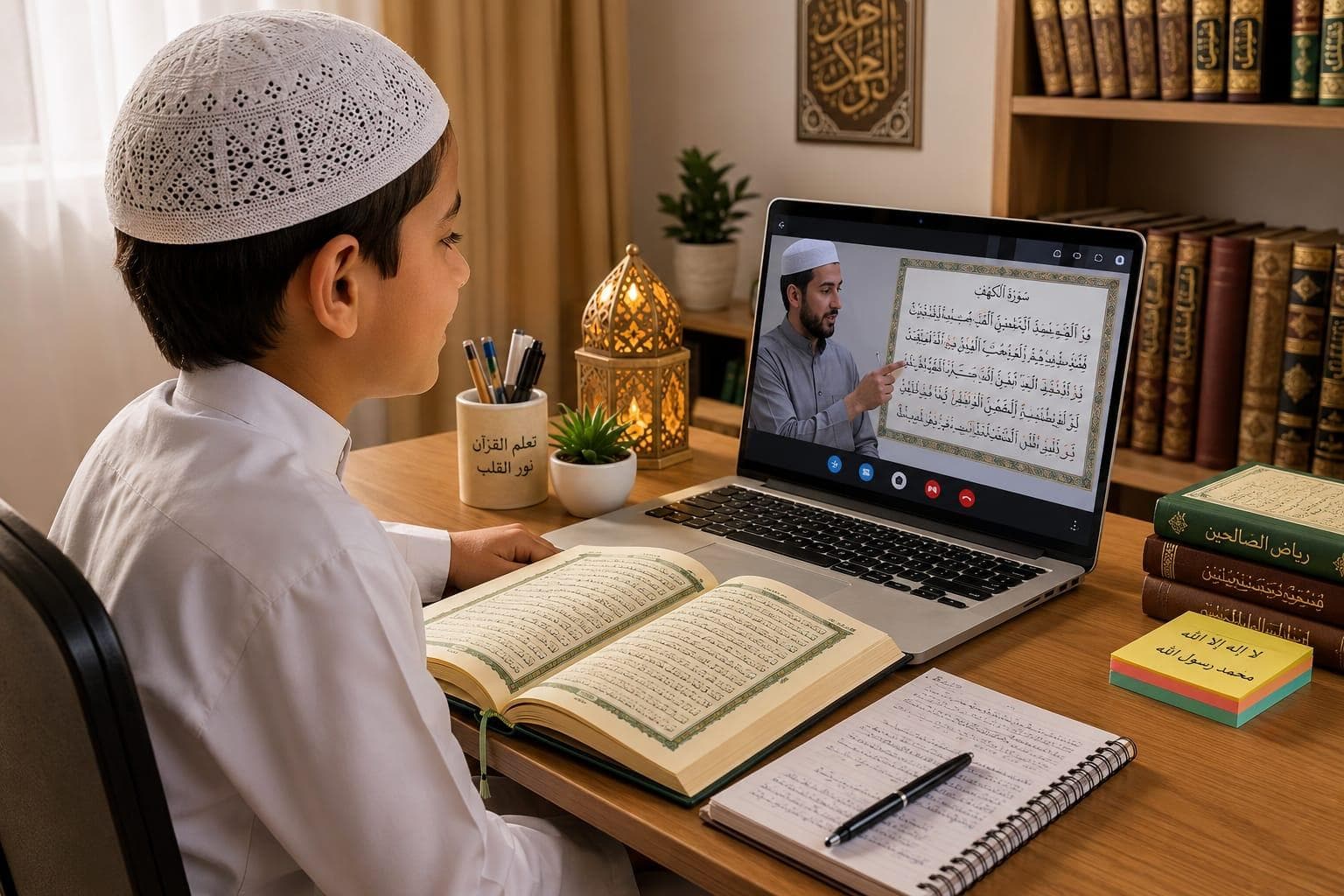
Quran Study Routine for Adults: How to Stay Consistent
Build a Quran study routine around real adult life: a realistic minimum, one primary goal, daily and weekly options, and a clear way to return after missed days — without guilt.
21 September 2026 · 14 min read · Fahm-ul-Quran Online Quran Academy
Adults rarely drop Quran study because they stop caring. They drop it because work shifts, children get sick, travel appears, and the plan they wrote for an ideal week no longer fits the week they actually have. The problem is usually design, not sincerity.
A useful Quran study routine for adults is built around real life: a realistic minimum, a clear time anchor, one primary goal, and a simple way to return after a missed day. Longer is not automatically better. A short routine you restart beats an ambitious schedule that collapses every Thursday.
This page is about consistency and structure. It is not another map of how to study one passage — that lives in how to study the Quran step by step. It is not a primer for learning Quran from scratch as an adult. And it is not the same as daily Quran reading practice, which stays with the reading habit itself.
Why Adults Struggle to Maintain a Quran Study Routine
The barriers are ordinary. Work hours move. Family needs interrupt the evening. Fatigue arrives before the page does. Commuting and travel break the anchor. Free time is uneven across the week, not evenly spaced like a timetable.
Other barriers are about the plan itself. Trying to study too much makes every session feel like a debt. Unclear goals turn ten minutes into scrolling. Relying on motivation alone means the routine only appears on good days. After a few missed sessions, many adults restart from zero instead of returning at the next realistic slot — and the restart becomes the habit.
What Makes a Quran Study Routine Sustainable?
Sustainability is a design property, not a personality trait. A routine that lasts usually has:
- A realistic minimum you can keep on a hard day.
- A clear time anchor attached to something already in your day.
- A manageable study target you can finish.
- A simple session structure so you do not invent the plan every evening.
- Regular review so yesterday’s work returns.
- Flexibility between busy and open days.
- A recovery plan after missed sessions — without doubling the next one.
None of these is a religious requirement. They are practical tools for adults with changing responsibilities.
Start With Your REAL Schedule, Not Your Ideal Schedule
Before you choose minutes, map the week you actually live. List fixed commitments. Mark realistic free periods. Note when your energy is usually higher and when it is usually low. Add one backup period for days when the main slot fails.
An ideal schedule looks neat on paper. A real schedule survives Tuesday. A fifteen-minute routine you follow can be more useful than an hour that repeatedly collapses. There is no universally optimal number of minutes — only a length you can protect most weeks.
Choose a Minimum Quran Study Routine
A minimum routine is the floor you return to when life is full. It should feel almost too small — small enough that you can still open the page on a busy day.
Examples only — not religious requirements:
- Very busy day: 5–10 minutes
- Normal day: 15–20 minutes
- More available day: 25–30+ minutes
The minimum protects continuity. The longer session is optional capacity, not the definition of a “real” day.
Choose One Primary Goal at a Time
Adults often try to improve Quran reading, Tajweed, memorization, translation, vocabulary, Tafsir, and reflection in the same short sitting. The session becomes a pile of unfinished starts.
Choose one primary goal for this season of your routine. Keep light review in other areas if needed. Examples:
- Reading-focused: reading + pronunciation correction
- Meaning-focused: reading + translation + concise Tafsir — see learn Quran with meaning
- Hifz-focused: new memorization + protected revision
- Returning learner: reading confidence + correction
No goal is universally superior. Match the goal to your current level and to the minutes you can keep.
Build Your Routine Around an Existing Part of the Day
New habits stick more easily when they attach to something already fixed. That is structure, not a claim that one clock hour is religiously preferred.
Common anchors adults actually use:
- after Fajr, if that slot is already quiet and protected;
- after returning from work, before the evening expands;
- after children leave for school;
- after children sleep;
- during a regular lunch break;
- before another established evening activity.
Pick the slot you can defend most often, then name a backup for the days that slot fails.
A Simple Daily Quran Routine for Adults
These are example educational routines. Adjust them to your level and primary goal. They are not religious requirements.
Option A — 10-minute routine
- 3 minutes — review yesterday’s line or notes
- 5 minutes — focused practice on today’s target
- 2 minutes — repeat the difficult part once more
Option B — 20-minute routine
- 5 minutes — review
- 10 minutes — main learning activity
- 5 minutes — recap and one note for tomorrow
Option C — 30-minute routine
- 5 minutes — review
- 15 minutes — main study
- 5 minutes — correction or careful repetition
- 5 minutes — notes or meaning review
If meaning is the main goal, keep the study method small and clear — the passage method is in how to study the Quran step by step. If vocabulary is growing beside meaning, learn Quranic Arabic can sit as a secondary layer, not a second full curriculum in the same ten minutes.
A Weekly Quran Study Routine for Busy Adults
Daily minutes need a weekly shape so the week is not random. The days below can be rearranged. Friday is not given a special religious status here — it is simply one slot in an example week.
- Monday: reading or lesson review
- Tuesday: Tajweed or pronunciation practice
- Wednesday: reading + meaning
- Thursday: review
- Friday: meaning or reflection if that fits your primary goal
- Saturday: longer review or a teacher-guided session
- Sunday: light review and plan next week
If your week is shift-based, rename the days by roles — “lesson day,” “review day,” “meaning day” — instead of forcing Monday–Sunday labels that do not match your roster.
How to Balance Reading, Tajweed, Meaning, and Memorization
Balance follows the weakest link and the primary goal:
- If reading is weak, prioritize reading and correction.
- If reading is established, add meaning and Tajweed refinement carefully.
- If memorizing, protect revision as firmly as new lines.
- If understanding is the main goal, combine reading, a reliable translation, a little vocabulary, and concise Tafsir — without turning every night into five subjects.
Adults whose main problem is finding a weekday slot for live classes may also find learning Quran online around a full-time job useful. Reading-focused adults can compare that path with Quran reading for adults.
What to Do When You Miss a Day
Missed days are normal. The recovery rule matters more than the miss.
Do not:
- double the next session;
- abandon the plan;
- restart the entire program;
- treat one missed day as failure.
Instead:
- return at the next realistic opportunity;
- review briefly;
- continue with the planned amount — not twice as much;
- adjust the schedule if the same slot keeps failing.
Consistency is built by returning, not by punishing yesterday.
What If You Miss a Whole Week?
A blank week needs a soft restart, not a heroic catch-up.
- Day 1: short review only — reopen the last page or notes.
- Day 2: return to your normal minimum.
- Day 3 onward: continue the normal schedule if it is still manageable.
If the schedule failed because it was unrealistic, redesign it. Trying harder on the same broken plan usually produces another blank week.
How to Create a Quran Routine Around Work and Family
Work and family are not obstacles to be narrated as failure. They are the conditions of adult life. Design for them.
- protect a short session you can actually keep;
- tell household members when that slot is, so interruptions are fewer;
- keep Quran materials ready — mushaf, notebook, bookmark — so setup does not eat the minutes;
- name a backup time for disrupted days;
- use the minimum on busy days;
- use a longer session when circumstances allow, without making that length the everyday requirement.
How to Build a Routine If You Are Returning After a Long Break
Returning is different from starting as a child. Begin gently:
- assess your current level honestly;
- choose one goal;
- start small;
- review before adding more;
- seek teacher correction where the sound or line is unclear;
- increase only if the routine remains sustainable.
If letters and joining are still the barrier, use learning Quran from scratch as an adult for the skill path, and keep this page for the calendar path.
How Online Quran Classes Can Fit Into an Adult Routine
A scheduled live lesson can give external structure: a fixed learning point, someone to hear the recitation, material to practise between sessions, and a form of accountability. It does not automatically solve an unrealistic home plan, and online is not automatically better than a local teacher.
Between classes, keep the home routine small enough that the lesson has something to correct. Adults who want understanding held in a live Urdu class can look at the Fahm-ul-Quran course; reading-focused paths sit on the academy’s Quran reading and related courses. Enrolment is a structure tool, not a guarantee of consistency. If a weekday live slot would help the routine hold, you can request a free 3-day trial and see whether the time and teacher fit.
For how long online learning usually takes in realistic terms — without fixed promises — see how long it takes to learn Quran online.
How to Track Your Quran Study Without Becoming Obsessed With Numbers
Light tracking helps you see whether the routine is real. A simple line is enough:
Date | Time | Activity | One thing learned | One thing to review
Tracking should clarify your week. It should not turn Quran study into a scoreboard. If the notebook becomes a source of pressure, simplify it.
Signs Your Quran Routine Needs Adjustment
Adjustment is a normal response — not a moral failure. Watch for:
- repeatedly missing the same sessions;
- constant postponement;
- sessions too long to finish;
- unclear learning objective;
- too many resources open at once;
- no review;
- fatigue making the final minutes unproductive;
- a schedule that no longer matches current responsibilities.
Change the minimum, the anchor, or the primary goal. Do not answer a broken design with guilt.
A 7-Day Quran Routine You Can Start This Week
This is one example for an adult beginner or intermediate learner. It is not universally ideal. Swap days to fit work and family.
- Day 1: 15 minutes — reading + review
- Day 2: 15 minutes — reading + correction
- Day 3: 20 minutes — reading + meaning
- Day 4: 10 minutes — review
- Day 5: 20 minutes — reading + meaning or concise Tafsir
- Day 6: 25 minutes — weekly review
- Day 7: 10 minutes — light review + plan next week
If Day 3 and Day 5 are too heavy, drop them to the 10-minute minimum and keep the week alive. Continuity is the point of the starter week.